
























Launching your own venture in the United Arab Emirates offers incredible opportunities for professional independence. The proprietary license, legally known as a Sole Establishment, is your most direct path to 100% ownership. This guide provides a clear, step-by-step roadmap for securing your license and thriving in 2026. Consequently, you can navigate the process with confidence, avoiding common pitfalls and ensuring full legal compliance. We will break down each critical stage, from understanding the legal framework to managing your long-term success.
Step 1: Understand the UAE Proprietary License Framework
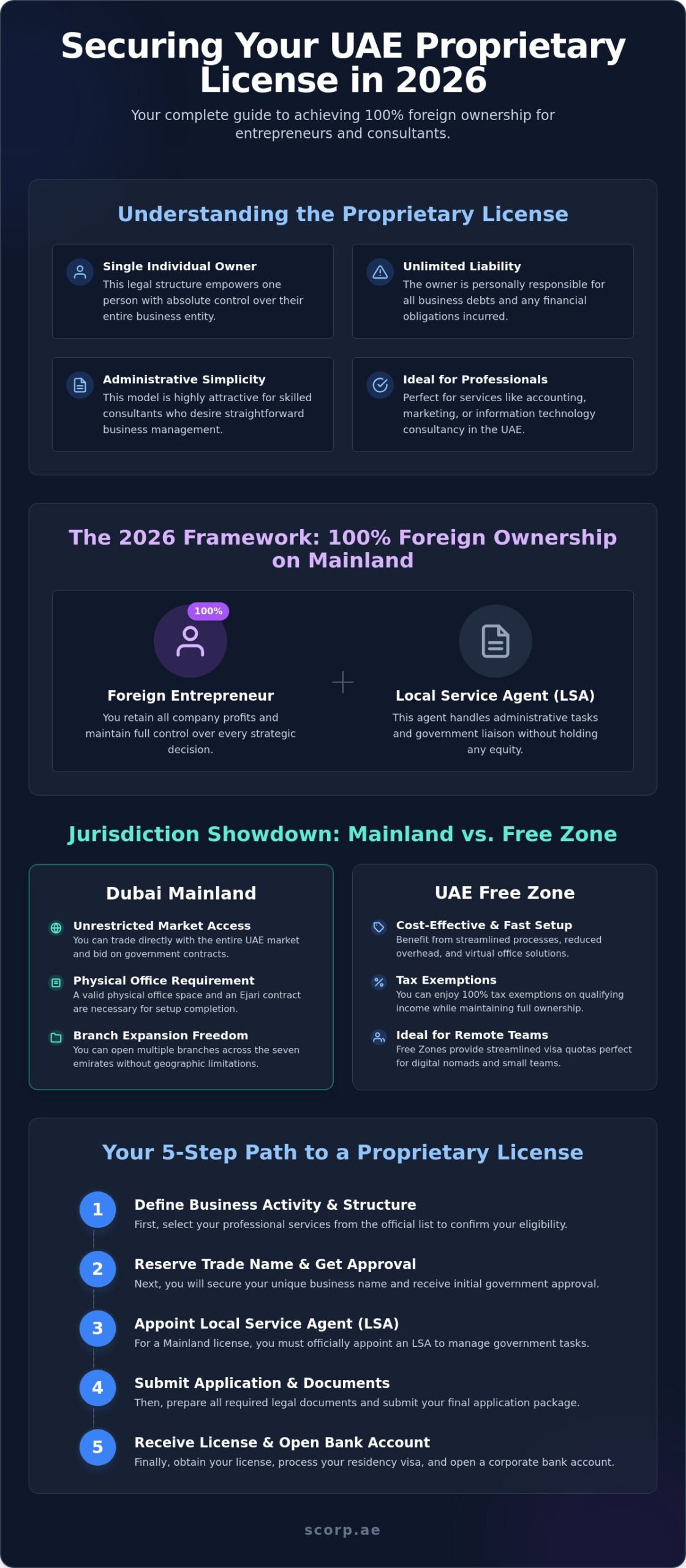
Your first step involves grasping the legal foundation of a proprietary license within the United Arab Emirates. This structure is specifically designed for a single individual who will assume all profits and liabilities. Furthermore, recent legal updates have made this option increasingly attractive for foreign professionals and expert consultants. Understanding these fundamentals is crucial before you commit to a specific business activity or jurisdiction for 2026.
The Legal Definition of a Sole Establishment
A proprietary license is not a company but rather a legal identity for an individual to conduct business. This entity is officially called a Sole Establishment and is 100% owned by a single person. According to the official UAE government portal, the owner holds unlimited liability for all business debts and obligations. Consequently, your personal assets are not legally separate from the business, unlike a Limited Liability Company (LLC). This structure remains exceptionally popular for service-oriented professionals who desire complete control over their operations.
100% Foreign Ownership and the Local Service Agent
Significant legal evolutions now permit 100% foreign ownership for most professional activities on the UAE Mainland. This change, rooted in updates to the Federal Decree-Law on Commercial Companies, empowers international entrepreneurs. However, for professional licenses, you must appoint a Local Service Agent (LSA) who is a UAE national. The LSA has no ownership stake or management rights, instead serving a purely administrative role for a fixed annual fee. Additionally, this agent facilitates interactions with government departments, ensuring your license remains compliant with local regulations.
Step 2: Choose Your Ideal Jurisdiction: Mainland vs. Free Zone
Selecting the right jurisdiction is a pivotal decision that will shape your business’s operational scope and growth. The UAE offers two primary environments for a proprietary license: the dynamic Mainland and efficient Free Zones. Each option presents distinct advantages regarding market access, operational costs, and administrative requirements for your business. Therefore, a careful analysis of your long-term goals is necessary to make the most strategic choice.
The Case for a Dubai Mainland License
A Mainland license, issued by Dubai’s Department of Economy and Tourism (DET), offers unrestricted market access. This allows you to trade directly with any customer or company located anywhere within the UAE. Furthermore, it enables you to bid on lucrative government contracts, a significant advantage for many consultants. A Mainland setup requires a physical office lease confirmed by an Ejari registration certificate from the authorities. This jurisdiction provides immense flexibility, including the ability to open multiple branches across different Emirates effortlessly.
The Case for a Free Zone Establishment
Free Zones are specialized economic areas that offer streamlined setup processes and significant financial incentives. Popular zones like IFZA and RAKEZ are known for their fast-track license issuance and simplified administration. Additionally, they provide cost-effective “Flexi-Desk” or virtual office solutions, which drastically reduce your initial overhead costs. Many Free Zones guarantee 100% exemption from corporate and personal income taxes for a specified period. For a deeper analysis, explore our detailed 2026 guide comparing Mainland and Free Zone options.
Step 3: Define Your Professional Activity and Reserve a Trade Name
With a clear understanding of your preferred jurisdiction, the next phase involves defining your business’s core functions. You must select a professional activity that accurately reflects your expertise from an official government-approved list. At the same time, you will need to choose and reserve a unique trade name for your establishment. This step is foundational, as your license will be directly tied to the activities you are permitted to perform.
Selecting an Approved Professional Activity
Your chosen business activity must align precisely with the codes provided by the relevant licensing authority. For a Mainland license, the DET maintains a comprehensive list of over 2,000 professional, commercial, and industrial activities. It is essential to match your skills and services to one of these predefined categories for legal operation. For instance, activities like management consultancy, IT services, and marketing are common choices for sole proprietors. This selection directly influences your legal structure and any additional approvals you may need to secure.
Reserving Your Unique Trade Name
The trade name for your sole establishment must adhere to specific government naming conventions for final approval. The name cannot include any offensive language or references to religious or political organizations like the FBI. Furthermore, if you use your personal name, it must be stated exactly as it appears on your passport. The trade name reservation process is now almost exclusively digital and can often be completed within 24 hours. Consequently, this allows you to proceed quickly with the subsequent steps of your business license application.
Step 4: Prepare and Legalize Your Foundational Documents
After receiving initial approval for your activity and trade name, you must compile and submit required documentation. The UAE has digitized many of these processes, making document submission more efficient and secure than ever before. For a proprietary license, the paperwork is relatively straightforward compared to more complex corporate structures. However, accuracy and completeness are paramount to avoid any unnecessary delays in your application processing timeline.
Essential Documentation for the Owner
The primary applicant, who is the sole owner, must provide several key personal documents for verification. You will need clear, color copies of your passport and, if applicable, your current UAE residency visa. A recent passport-sized photograph with a white background is also a standard requirement for the application. Additionally, some professional activities may require educational certificates or letters of experience to be attested by authorities. Preparing these items in advance will significantly streamline the entire submission process for your new license.
Drafting the LSA Agreement or MOA
For a Mainland professional license, you must have a legally drafted Local Service Agent agreement. This document outlines the LSA’s responsibilities and your complete control over the business and its profits. In 2026, the signing of these legal documents is now a mandatory digital process for increased security. For certain Free Zone establishments, a standard Memorandum of Association (MOA) may be required instead. This document serves as the constitution of your establishment, detailing its purpose and operational framework for approval.
Step 5: Secure Your Official Business Address
Every licensed business in the UAE must have a registered physical address within the country. This requirement is a critical component of the licensing process and demonstrates your tangible presence. The type of address you need depends directly on the jurisdiction you selected in the earlier stages. Both Mainland and Free Zone authorities have specific rules regarding the validity of a business address.
The Mainland “Ejari” Requirement
A Dubai Mainland license mandates a physical office space that is registered through the official Ejari system. This government portal registers tenancy contracts, providing a unique Ejari certificate required for your license application. The office must be in a commercial building, and its size may be subject to DET inspection. This ensures that your business operates from a legitimate, verifiable location within the mainland of the emirate. Consequently, this step solidifies your business’s physical footprint and credibility in the local UAE market.
Free Zone Virtual Office Solutions
In contrast, Free Zones offer more flexible and cost-effective solutions for your business address requirement. Most free zones provide “Flexi-Desk” or shared workstation packages that satisfy their licensing criteria without a traditional office. These virtual office options give you a registered address and access to meeting rooms on an as-needed basis. Additionally, this approach is ideal for consultants and digital nomads who do not require a permanent physical workspace. It significantly reduces initial setup costs and allows you to allocate capital to other core business areas.
Step 6: Finalize Payment and Receive Your License
The final step in the formal application process is the submission of all documents and payment of fees. Once the authorities have reviewed and approved your complete file, they will issue a payment voucher. This voucher consolidates all government fees required to issue your proprietary trade license and related documents. Prompt payment is essential to ensure your business can commence its operations legally and without any delay.
Upon successful payment, you will receive your official trade license from the governing authority. This document is your legal permission to conduct the specified professional activities within your chosen jurisdiction. Alongside the license, you will also receive an establishment card, which is crucial for visa processing. This card registers your business with the immigration authorities, allowing you to sponsor yourself and your family. Therefore, completing this step marks the official birth of your new UAE sole establishment.
Step 7: Navigate 2026 Corporate Tax and Compliance
Receiving your trade license is a major milestone, but your responsibilities do not end there. In 2026, all businesses, including sole establishments, must adhere to the UAE’s compliance framework. This includes understanding the implications of Corporate Tax and fulfilling other regulatory reporting requirements. Staying informed about these obligations is vital for maintaining your license in good standing for the future.
Corporate Tax for Sole Proprietors
The UAE’s Corporate Tax law applies to sole establishments with net profits exceeding AED 375,000 per year. Profits above this threshold are taxed at a standard rate of 9%, as detailed by the Federal Tax Authority. It is crucial to distinguish between your personal salary and the business’s taxable profits for accurate accounting. Furthermore, the government offers Small Business Relief options that may exempt you from tax if your turnover is low. Maintaining meticulous financial records is mandatory to satisfy any potential audits and ensure full compliance.
VAT and UBO Declarations
Beyond Corporate Tax, you must also consider Value Added Tax (VAT) and other reporting duties. VAT registration becomes mandatory if your annual revenue from taxable supplies exceeds AED 375,000. For comprehensive guidance, you can review our complete 2026 guide to VAT registration. Additionally, all businesses must maintain a register of their Ultimate Beneficial Owner (UBO) and submit this information to the authorities. This declaration enhances transparency and is a key part of the UAE’s anti-money laundering framework.
Step 8: Open Your Corporate Bank Account
With your license and establishment card in hand, you can now open a corporate bank account. This is a non-negotiable step for separating your personal and business finances, which is essential for accounting. The UAE’s banking sector has evolved, offering both traditional institutions and modern digital-first banks. Choosing the right banking partner will depend on your specific business needs and transaction volumes.
Digital-first banks like Wio offer a streamlined, online-first onboarding process ideal for modern entrepreneurs. In contrast, traditional banks such as Emirates NBD provide a wider range of services and a physical branch network. Regardless of your choice, you will need to complete a Know Your Customer (KYC) process. This typically requires your trade license, passport, visa, and a business plan for the bank’s review. For expert assistance, discover who can help you open a bank account in Dubai.
Step 9: Secure Your Residency and Future Growth
Your proprietary license is the key that unlocks your long-term residency in the United Arab Emirates. It serves as the foundation for obtaining an investor visa, which provides security for you and your family. Partnering with a corporate services provider can make this final phase of your setup journey completely seamless. This ensures all visa and residency formalities are handled efficiently, allowing you to focus on your business.
Frictionless Residency and Investor Visas
As the owner of a sole establishment, you are eligible to apply for a UAE investor visa. This residency permit is typically valid for two years and can be renewed indefinitely with a valid license. Sarsan Corporate Services facilitates this entire process, from initial entry permit to final Emirates ID stamping. Additionally, we provide comprehensive support for sponsoring your family members, including your spouse and children. This holistic approach ensures your transition to living and working in the UAE is smooth and stress-free. To learn more, read our 2026 guide on securing an investor visa.
Your Partner for Long-Term Success
Sarsan Corporate Services is more than just a setup agent; we are your long-term strategic collaborator. Our end-to-end service model handles every detail, from initial licensing to ongoing compliance and visa renewals. We believe in complete pricing transparency, eliminating the risk of unexpected fees during the setup process. Our commitment extends beyond licensing to support your continued growth and success in the dynamic Dubai market. Therefore, we invite you to begin your journey toward business independence with a trusted and seasoned guide. Contact Sarsan Corporate Services today to receive a personalized 2026 setup roadmap for your business.