




















The most popular choice for startups in 2024 often becomes a costly mistake by the time 2026 arrives. You likely feel overwhelmed by shifting regulations regarding 100% foreign ownership and the recent 9% corporate tax implementation. It is natural to worry about hidden setup costs that could drain your capital before you even launch. Consequently, choosing between a free zone vs mainland in the UAE which is better depends entirely on your specific trade activities.
We promise to clarify these jurisdictional differences so you can select the most profitable path for your unique goals. You deserve a seamless transition into the market without the burden of administrative confusion or unexpected financial surprises. Therefore, this guide provides a direct comparison of ownership rules, tax eligibility, and visa requirements for the upcoming year. Our expert analysis will simplify the licensing process and reveal the true costs of establishing your corporate presence. You’ll gain a clear understanding of every requirement to ensure your business thrives in the competitive UAE market.
Key Takeaways
- Distinguish between Mainland’s onshore reach and Free Zone’s specialized economic focus to align your setup with your long-term business goals.
- Evaluate market access to determine which is better for your specific trading and service goals.
- Examine 2026 corporate tax implications and setup costs in AED to ensure your chosen jurisdiction maximizes long-term profitability and growth.
- Apply our strategic decision framework to select a jurisdiction based on your target client location and industry requirements for success.
- Partner with Sarsan Corporate Services for a seamless formation process that offers transparent pricing and expert guidance through every step.
Understanding the UAE Business Landscape: Free Zone and Mainland Explained
Choosing between a free zone and mainland setup is the first major decision for any entrepreneur in the Emirates. This choice dictates your market access, regulatory requirements, and long-term growth potential within the region. As we approach 2026, the UAE continues to refine its hybrid economy to attract global talent and investment. The Mainland functions as an onshore jurisdiction managed by the Department of Economy and Tourism (DET) in each Emirate. Conversely, UAE Free Zones operate as independent economic areas with their own unique regulatory frameworks. Both jurisdictions are essential pillars of the Dubai Economic Agenda D33, which aims to double the size of Dubai’s economy by 2033. Understanding these differences helps you decide if whether a free zone or mainland license is suitable with your specific business model.
The UAE’s economic strategy for 2026 creates a collaborative environment where both jurisdictions play vital, complementary roles. International investors often find that a hybrid approach allows them to leverage the unique strengths of each business environment. It’s essential to partner with an expert who provides end-to-end solutions for your new venture. Our team helps you navigate these complexities to ensure your company is positioned for maximum growth and efficiency. Evaluating this comparison requires a clear understanding of your 2026 commercial goals.
What is a UAE Free Zone Company?
Free zones are specialized hubs designed to support specific industries through tailored regulations and infrastructure. For example, the DMCC focuses on commodities while IFZA provides streamlined solutions for professional services and consultancy firms. These zones use geographic ring-fencing to manage business activities within their designated boundaries. Historically, these areas provided 100% foreign ownership and zero customs duties for international trade. Even with recent law changes, they remain popular for their efficient Dubai business setup services and industry-specific networking opportunities. They offer a fast-track entry for companies that primarily trade internationally or provide digital services.
What is a UAE Mainland Company?
A mainland company is an onshore entity that allows you to trade freely throughout the local UAE market. These businesses can bid for high-value government contracts and operate across all seven Emirates without any geographic restrictions. The Department of Economy and Tourism (DET) manages the licensing process and ensures all entities follow national commercial laws. Since the update to the Commercial Companies Law in 2020, foreigners can own 100% of many mainland enterprises. This jurisdiction is ideal for retail, construction, and any service requiring a physical presence in the local community. It provides the most flexible path for businesses looking to integrate deeply into the domestic economy.
Key Operational Differences: Where Can Your Business Actually Trade?
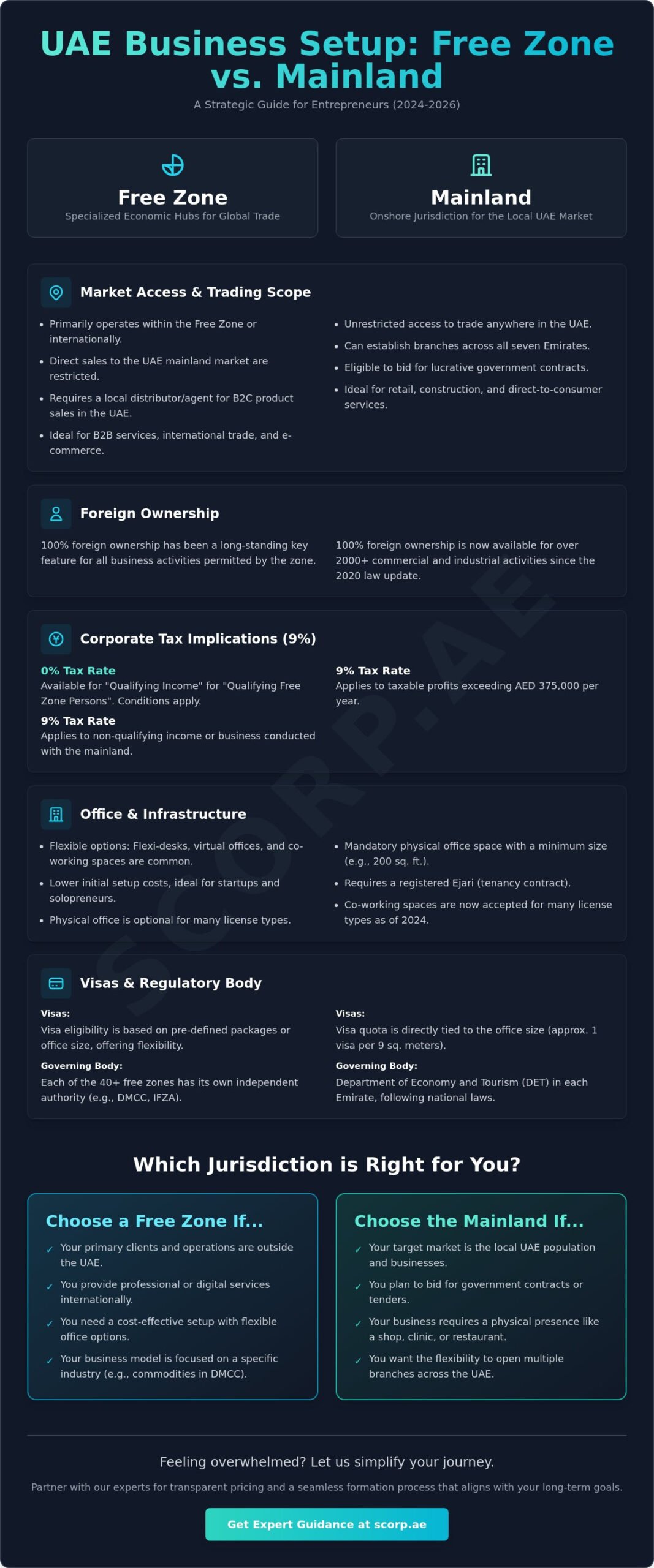
Choosing between a free zone and mainland better depends on your target customers. Free zone companies traditionally operate within their specific geographic boundaries or focus on international markets. Mainland companies enjoy the freedom to trade anywhere in the Emirates without any territorial restrictions. You can open multiple branches in different Emirates under a single license while maintaining consistent operations. This flexibility allows your business to scale across the country as your local customer base grows.
Territorial Restrictions and Market Access
Free zone entities often face limits when selling services directly to the local B2C market. You can engage in B2B transactions with mainland companies through established legal channels and professional intermediaries. Mainland businesses benefit from direct access to the UAE’s domestic market, which is expanding rapidly in 2026. Navigating these complex territorial regulations requires expert guidance to ensure your company remains fully compliant. You can explore Dubai business setup services to streamline this entire registration process. This support helps you understand the UAE’s startup economy and its unique jurisdictional boundaries. If you sell physical goods from a free zone, you must use a local distributor. These agents handle the customs duties and logistics required to move products into the mainland market.
Office Space and Physical Infrastructure Requirements
Mainland licenses require a physical office space with a minimum size of 200 square feet. This physical presence directly determines your visa quota, usually allowing one visa for every nine square meters. Free zones offer Flexi-desks or virtual offices, which are ideal for startups with limited budgets. These options provide a legal address without the high costs of a dedicated commercial unit. Modern co-working spaces are now legally recognized for many mainland licenses as of 2024. This trend offers entrepreneurs more flexibility while maintaining a professional presence in the city. If you’re ready to find the perfect location, our team can help you book a consultation today.
Comparing Setup Costs, Taxation, and Ownership Structures in 2026
Deciding between a free zone or mainland for your UAE venture requires a clear look at your financial roadmap. Mainland companies usually face higher initial costs due to mandatory physical office leases and various government registration fees. Free zones offer more affordable entry points through flexible desk solutions and bundled license packages. However, you must consider long-term operational expenses like visa renewals and annual audit requirements. For a detailed financial breakdown of these variables, you should review the cost of business setup in UAE to plan your budget effectively.
Taxation and customs duties also play a massive role in your decision. While both structures now operate under the federal corporate tax regime, the application differs significantly based on your business activity. You need to evaluate where your primary customers are located before committing to a specific jurisdiction. This strategic choice impacts your profit margins and your ability to scale within the local market.
The 100% Foreign Ownership Revolution
The 2021 legislative shift transformed the UAE business environment by removing the 51% local Emirati ownership requirement for mainland companies. This change allows international entrepreneurs to maintain full control over their commercial and industrial operations. You no longer need a local partner for the vast majority of business activities in Dubai or Abu Dhabi. This makes the mainland a very attractive option for those who want total authority over their corporate governance.
Some restrictions still apply to specific sectors identified on the “Positive List” by individual emirates. These activities usually involve strategic industries like oil and gas, telecommunications, or defense. You might still need special approvals or a local majority shareholder for these high-impact sectors. Most retail, consulting, and manufacturing businesses can now enjoy 100% ownership without any hurdles. Our team at Sarsan Corporate Services can help you verify if your specific activity qualifies for full ownership on the mainland.
Corporate Tax and Customs Duty Implications
The UAE Corporate Tax law applies a standard 9% rate on taxable income exceeding AED 375,000. Mainland businesses must pay this tax on all adjusted accounting profits earned within the country. Free zone companies can potentially maintain a 0% corporate tax rate if they qualify as a “Qualifying Free Zone Person.” To achieve this, you must earn “Qualifying Income” and maintain adequate economic substance within your specific zone. Compliance is strict, and failing to meet these standards results in the standard 9% tax application.
Customs Duties: Goods moved from a free zone into the mainland are subject to a 5% customs duty.
VAT Registration: Both mainland and free zone entities must register for 5% VAT if taxable supplies exceed AED 375,000.
Audit Requirements: Most jurisdictions now require annual audited financial statements to ensure tax compliance.
Understanding these fiscal responsibilities is essential when choosing for your specific trade model. If you plan to distribute goods directly to the local UAE market, a mainland license often saves you the 5% customs duty. For businesses focused on international re-exports, the free zone structure remains the most tax-efficient choice. You can contact us today to receive a tailored tax impact assessment for your new company.
Decision Framework: Choosing the Right Jurisdiction for Your Industry
Selecting a jurisdiction requires a clear strategy based on your target market and operational needs. You should ask yourself several vital questions before making a final commitment. Where do my primary clients live? Do I need a physical shop on a public street? Will I bid for government contracts? Your answers determine which license is suitable your specific business goals. Establishing these priorities early prevents operational friction as your company grows.
When to Choose a Free Zone Setup
Free Zones are ideal for businesses focusing on international exports, digital services, or niche consulting roles. Tech startups and digital nomads prefer these zones because they offer 100% foreign ownership and streamlined digital processes. You can often launch your business within three working days in specific digital hubs. This speed allows entrepreneurs to test ideas without significant delays or complex local sponsorship requirements. For detailed recommendations on specific locations, read our Dubai Free Zone Company Setup guide to find your ideal match.
When a Mainland License is Essential
Any business requiring a physical presence on the high street must opt for a Mainland setup. Retail shops, construction firms, and logistics providers usually need this license to operate across the entire country. Mainland companies can also bid for lucrative government tenders and work in regulated fields like healthcare. Researching starting a business in Dubai for foreigners often begins with a Mainland feasibility study. This ensures your business model complies with Department of Economy and Tourism (DET) regulations from the first day.
Future-proofing your choice is vital to avoid expensive jurisdiction transfers later in your entrepreneurial journey. Moving a company from a Free Zone to the Mainland involves high administrative costs and legal restructuring. You should analyze your five-year growth plan before you commit to a specific trade license or location. A well-planned setup provides a seamless path to expansion without the need for redundant paperwork or extra fees. Use the following checklist to evaluate your needs:
Identify if your clients are based locally or internationally.
Determine if you need a warehouse or a street-level retail space.
Assess the importance of bidding for UAE government contracts.
Evaluate the need for unlimited employee visas as you scale.
Choosing between a free zone and mainland depends on these specific operational requirements. Our team helps you weigh these factors to ensure your license supports your long-term vision. We provide the expertise needed to navigate these regulations with total confidence and clarity.
Get an expert consultation to streamline your business setup process today.
Seamless Company Formation with Sarsan Corporate Services
Deciding on a business structure is a critical step that defines your company’s future growth and operational limits. Sarsan Corporate Services acts as your expert guide your UAE startup. Our consultants analyze your specific business activities to ensure you select the most profitable and compliant jurisdiction available. We’ve helped over 10,000 entrepreneurs transform their professional aspirations into successful UAE realities with absolute confidence. We prioritize honesty and clarity by offering fixed packages with no hidden costs or unexpected administrative fees. This transparent approach allows you to plan your investment with certainty while we handle the technical details.
Our End-to-End Formation Process
Our team manages every detail of the setup process to save you valuable time and effort. We handle all documentation, legal translations, and government approvals through a streamlined and efficient workflow. Our specialists manage the entire journey from initial trade name reservation to the final issuance of your business license. Securing a corporate bank account remains one of the most challenging steps for new entrepreneurs in the region. We provide hands-on assistance to help you navigate banking compliance and set up your accounts without delays. Please contact us to receive a customized roadmap designed for your specific industry and goals. We ensure your application adheres to all 2026 regulatory standards to prevent any unnecessary processing hurdles.
Professional trade name reservation and initial approval management.
Drafting and notarization of Memorandum of Association (MOA) and other legal documents.
Comprehensive assistance with corporate bank account opening and KYC compliance.
Expert guidance on deciding for your long-term expansion.
Ongoing Support and Visa Facilitation
Establishing your company is just the beginning of our partnership in the vibrant UAE business ecosystem. We facilitate the entire residency visa process to ensure you and your employees can live and work legally. Our team handles medical screenings, Emirates ID applications, and final visa stamping for your family and staff members. Beyond setup, we provide essential corporate services like VAT registration and annual compliance audits to protect your license. We also manage your annual license renewals and corporate secretarial tasks to prevent any late penalties or disruptions. Sarsan Corporate Services remains your dependable ally as you navigate the evolving regulations of the 2026 market. Our end-to-end solutions remove the administrative burden so you can lead your business with absolute peace of mind.
Future-Proof Your Business Strategy in the Emirates
Choosing the right jurisdiction ensures your company thrives in the evolving 2026 business landscape of the Emirates. Free zones provide excellent tax benefits, yet mainland licenses allow you to trade directly with customers across the UAE. You must evaluate your distribution needs and ownership requirements before you finalize your official registration documents today. This is a critical step.
Also, we offer transparent pricing with no hidden costs while managing your entire application through end-to-end corporate solutions. Our team handles the heavy lifting so you can focus on growing your new enterprise with confidence. You’ll find that our streamlined approach saves time and removes the stress of navigating local government regulations.
Start your hassle-free UAE business journey with SCORP today!
Your vision deserves a dedicated partner that turns complex paperwork into a seamless reality for your brand.