



















What if you could shield your private assets from legal claims while maintaining total control over your family legacy? As a result, many successful people feel uneasy about how local family rules might affect their diverse global wealth. You deserve a solution that offers both legal certainty and the freedom to manage your wealth on your terms. Setting up a foundation company structure in the UAE provides this security by creating a separate legal entity for your assets.
Indeed, this strategic move effectively builds a firewall between your personal debts and the capital you want to save. Therefore, this guide explores how a UAE foundation secures your legacy and ensures a smooth transition for your heirs. We will closely look at the unique benefits of zones like DIFC and ADGM to find your best fit. In fact, we provide the clarity you need to handle these rules with total confidence and an expert approach. Finally, you’ll discover why this modern corporate model is often better than older trust structures for global asset protection.
Key Takeaways
- Learn how the UAE foundation acts as a hybrid entity that combines corporate control with traditional trust benefits.
- Discover how a foundation company structure in the UAE shields your personal wealth from creditors while securing your long-term family legacy.
- Compare the top jurisdictions like ADGM and DIFC to find the most efficient and prestigious home for your assets.
- Explore why these structures offer more control than trusts because you can actively participate in the foundation council.
- Understand the step-by-step process of drafting charters and appointing registered agents to ensure a smooth, frictionless setup journey.
Understanding the UAE Foundation Company Structure in 2026
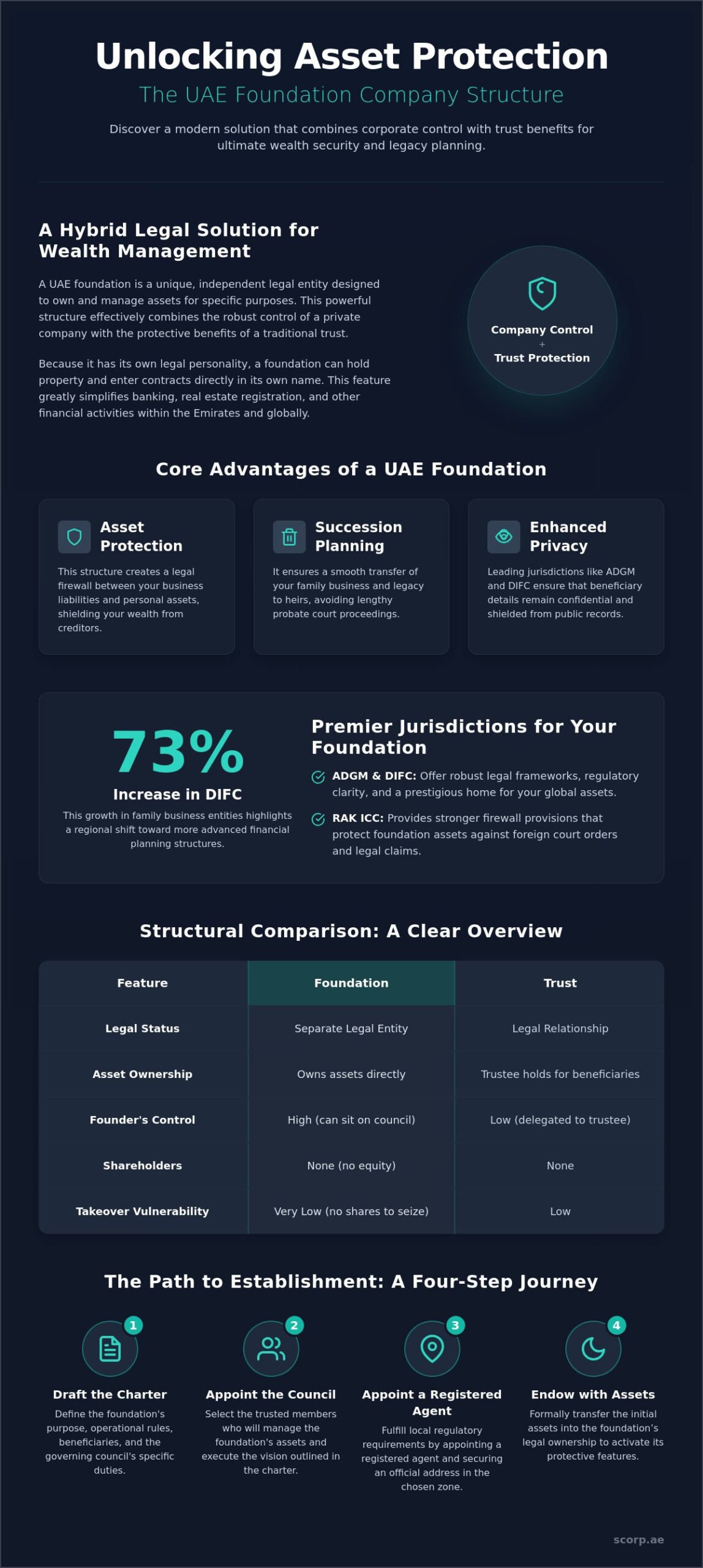
A UAE foundation acts as a unique independent legal entity that owns assets for specific purposes. This legal vehicle combines the best features of common law trusts and private limited companies. Consequently, foundations possess their own legal personality, which allows them to enter contracts and hold property. Within the broader framework of UAE corporate law, these structures offer robust security for global wealth. This specific foundation company structure in the UAE is designed for wealth management, succession planning, and robust asset protection. Unlike a traditional trust, a foundation owns its assets directly in its own name. This distinction simplifies the process of opening bank accounts and registering real estate within the Emirates. It’s a powerful tool for high-net-worth individuals who require a stable and predictable environment. Sarsan acts as a dependable guide to help you establish this structure with absolute financial clarity.
The Rise of Foundations in the Middle East
Regional investors increasingly choose foundations to avoid traditional probate and inheritance legal delays. These structures offer a familiar legal framework for international investors who are accustomed to European civil law. Additionally, 2025 amendments to RAK ICC regulations introduced stronger firewall provisions to protect your global assets. In fact, the number of family business entities in the DIFC rose by 73% in early 2025. This growing popularity reflects a shift toward more advanced and transparent financial planning in the region.
Key Benefits of Establishing a UAE Foundation
Setting up a foundation company structure in the UAE offers a strong shield against creditors by keeping personal wealth from legal debts. This setup ensures that your global assets stay safe regardless of outside legal claims or personal money problems. Therefore, you gain the freedom to give your wealth exactly as you wish without facing local legal limits. Foundations don’t just offer safety; they provide tax savings when linked with a cost of a business setup in a UAE plan.
Succession Planning and Legacy Security
Foundations ensure that family firms continue to work well after the founder passes away without any major work stops. The board follows strict rules to give wealth according to the founder’s exact written wishes and long-term goals. This structure removes the need for long and costly court cases that often delay asset transfers for many years. In fact, a foundation provides a smooth shift of power that protects the firm and the family’s future.
Asset Protection and Privacy
Assets held in a foundation are not reachable by personal legal claims or lawsuits from various third-party creditors. Foundations provide a high level of privacy for rich people who want to keep their money life very private. Privacy laws in places like ADGM ensure that their details stay safe from public records and unknown third parties. Clearly, the firewall rules in UAE law prevent foreign court orders from easily touching the assets held within foundations.
Beyond that, these entities act as a holding tool that makes the management of diverse and complex global funds possible. Founders often choose this model because it lets them keep control without the risks of direct personal ownership. You can join the board to oversee the strategic path of the foundation during your own lifetime. This role is often higher than what you would find in a private trust structure.
Comparing Foundations, Trusts, and Private Companies
Foundations offer more control than trusts because the founder can often sit on the governing council directly. Unlike trusts, which represent a legal relationship, a foundation exists as a distinct and independent legal person. This independent status allows the foundation company structure in the UAE to own property and sign contracts in its name. Consequently, banks and local authorities often find it much easier to recognize these registered and regulated entities. You can appoint yourself as a council member to oversee how the entity manages your global wealth. This direct involvement ensures that your original vision for the assets remains the top priority for years.
In addition, foundations do not have shareholders, which prevents hostile takeovers or internal equity disputes between parties. Since there are no shares to issue, you eliminate the risk of external parties seizing ownership interests. This unique feature makes the foundation an ideal vehicle for holding a holding company or other sensitive assets. Therefore, you can separate your active commercial operations from your long-term family wealth and legacy goals. You won’t have to worry about minority shareholders challenging your decisions or disrupting the smooth flow of business. These structures provide a level of stability that traditional corporations simply cannot match in complex family wealth scenarios.
Foundations vs. Common Law Trusts
A foundation provides the founder with more direct influence over asset management than a traditional common law trust. Trusts often face challenges in civil law jurisdictions where the concept of split legal title is mostly unknown. By contrast, foundations are fully compatible with local laws and offer a clear and transparent governance structure. This clarity ensures that your legacy remains secure while you maintain the power to guide the foundation council. Because the foundation is a registered entity, you receive a certificate of incorporation to prove its legal standing. This official status simplifies the process of transferring assets into the structure without facing unnecessary legal hurdles.
Foundations vs. Holding Companies
Traditional companies focus on active commercial trade, while foundations focus on holding and protecting your existing family wealth. Combining both structures allows an entrepreneur to learn how to start a business in Dubai for foreigners while securing the parent entity. Because foundations lack shares, they provide a robust firewall that commercial companies simply cannot offer on their own. Sarsan helps you integrate these structures to achieve a seamless balance between active growth and long-term security. You can run your daily business operations through an LLC while the foundation holds the underlying capital safely. This multi-layered approach creates a powerful defense against potential business risks and ensures your family remains protected.
Top UAE Jurisdictions for Foundation Setup
Choosing the right jurisdiction is the most critical step when you create a foundation company structure in the UAE. Different free zones offer distinct legal benefits that cater to your specific budget and long-term asset goals. You must evaluate the trade-off between international prestige and the total cost of maintaining your legal structure. Sarsan provides expert guidance to help you select the most efficient path for your unique family legacy needs. Our team ensures that your chosen location aligns perfectly with your goals for asset protection and growth. We focus on delivering a frictionless experience that allows you to focus on your primary business objectives.
ADGM and DIFC: The Premium Options
DIFC and ADGM are the premium choices because they operate under a highly respected common law legal framework. In fact, the number of family business entities in the DIFC grew by 73% in early 2025. This growth reflects the strong trust that global investors place in the robust legal systems of these zones. DIFC foundations are especially useful for holding high-value Dubai real estate due to their streamlined land department links. You should also consider the annual operating license fees and data protection costs when planning your initial budget. Meanwhile, ADGM is often the preferred choice for complex corporate structuring and sophisticated family office management tasks. Both zones provide a dedicated court system to resolve any disputes with high levels of legal certainty. These premium jurisdictions offer an elite environment that matches the high standards of global wealth management professionals.
RAK ICC: The Efficient Offshore Alternative
RAK ICC provides a more cost-effective offshore solution for investors who don’t require a physical Dubai presence. This jurisdiction is an excellent choice for holding international assets and intellectual property at a much lower price. You don’t need a physical office, which makes the setup process extremely fast and efficient for busy professionals. The 2025 amendments to RAK ICC rules have further strengthened the firewall provisions for all registered entities. These updates established a three-year statute of limitations for anyone who wants to challenge your asset transfers. RAK ICC foundations can still own property in specific Dubai areas through approved and verified legal channels. This flexibility makes it a popular choice for those who want to secure assets without high overhead costs. It’s a straightforward and manageable process that offers great confidentiality for high-net-worth individuals and families.
Each jurisdiction has specific requirements regarding local registered agents and the filing of annual compliance and audit reports. You must appoint a qualified agent to handle the application and maintain regular communication with the free zone. The council must manage the assets according to the charter while following the specific by-laws you provide. SCORP simplifies this daunting regulatory journey by managing every detail of your registration from start to finish. We offer transparent financial clarity and ensure that you never face unexpected fees during the annual renewal phase. You can explore our complete formation services to find the right jurisdiction for your goals. Our seasoned experts act as collaborators to help you navigate the complex regulatory environment with total confidence.
How to Establish Your UAE Foundation with Sarsan Corporate Services
Establishing a foundation company structure in the UAE requires a clear strategy and a dedicated partner to handle the paperwork. First, you must define the core purpose and draft the foundation’s charter and its detailed by-laws. Consequently, Sarsan Corporate Services manages the entire registration process to ensure a rapid and frictionless setup journey. We help you select a qualified registered agent to facilitate your application with the chosen free zone. Once the entity is officially registered, we assist with the legal transfer of assets into the foundation’s name. This final step ensures your wealth receives full protection under the robust legal framework of the Emirates. Indeed, we act as a seasoned guide to simplify the complex journey of protecting your global family assets.
Required Documentation and Compliance
Founders must provide proof of identity, current address, and a clear description of the assets being transferred. Additionally, the foundation must appoint council members and, in some cases, a guardian to oversee the council’s actions. Regular annual filings and compliance checks are necessary to maintain the foundation’s active and legal status over time. Sarsan simplifies this complex process by providing a clear checklist of every document you will need to submit. Our team ensures that your application meets all regulatory standards to avoid any unnecessary delays or complications. Therefore, we handle the technical terminology and regional regulatory frameworks to establish your credibility within the local market.
Ongoing Support and Asset Management
Sarsan provides comprehensive business setup services to manage any underlying companies the foundation owns. We offer expert guidance on VAT compliance and corporate tax obligations for foundations that hold commercial interests. Our team remains a long-term collaborator to update your by-laws as your family or business grows larger. We focus on providing financial clarity and post-service continuity to protect your legacy for the next generation. You can trust our experienced guides because it’s our mission to handle the daunting regulatory environment for you. Finally, our commitment to transparency ensures that you never face hidden fees or unexpected administrative hurdles during the process. Our goal is to create a clear and frictionless path that allows you to achieve your business goals.
Secure Your Global Legacy with Expert Precision
Choosing a foundation company structure in the UAE is a very smart move to protect your global assets and family legacy. Next, you now understand how these entities offer better control and privacy than older trust or company models. Whether you pick the prestige of DIFC and ADGM or the speed of RAK ICC, your wealth stays safe. Indeed, Sarsan Corporate Services provides expert help across all major zones with ten years of local business work. We offer clear pricing with no hidden fees while we handle your entire setup process from start to finish. Thus, our team acts as a reliable partner to simplify the tough legal journey for your total peace of mind. Secure your legacy today with Sarsan Corporate Services to start your own business journey in the great Emirates today. Finally, it’s time to build a strong future for your family with the expert help of our seasoned team.