



















What if the secret to your 2026 global expansion isn’t just about moving goods, but about which of Dubai’s 40 plus free zones you call home? If you’re currently thinking, “I want to do international trading, but which license is good for me in Dubai?,” you’re likely feeling the weight of over 2,000 available business activities and varying fee structures. It’s understandable to feel overwhelmed by complex customs regulations or the fear of hidden setup costs that can unexpectedly inflate your budget by 12,500 AED or more.
You’ve worked hard to build your vision, and you deserve a setup process that’s as ambitious as your business plan. Discover how to secure 100% foreign ownership and zero corporate tax eligibility while processing your residency visa in as little as 5 working days. This guide provides a clear roadmap through the business landscape, ensuring your international trading hub is built on a foundation of speed, transparency, and end-to-end support. We’ll break down the best licensing options for 2026 to make your transition into the UAE market completely seamless.
Key Takeaways
Understand why the Commercial License is the essential vehicle for global commerce and how to choose between specific and general trading activities.
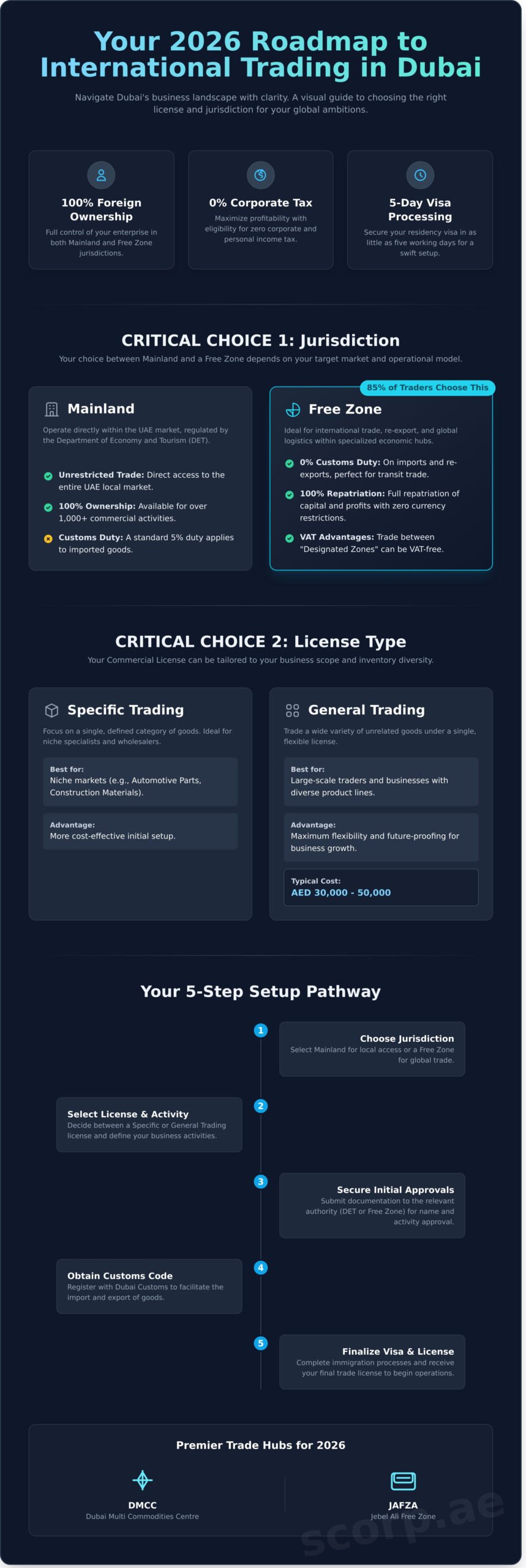
Compare the strategic advantages of Mainland and Free Zone jurisdictions, including 100% foreign ownership and 0% customs duties on re-exports.
Identify the premier trade hubs for 2026 to position your business for maximum growth.
Learn how to leverage end-to-end solutions from Sarsan Corporate Services to ensure a seamless, hassle-free transition into the UAE’s thriving trade ecosystem.
Choosing the Right License for International Trading in Dubai
Dubai enters 2026 as the undisputed pivot point for East-West trade. The city’s D33 Economic Agenda has already pushed foreign trade volumes toward a target of AED 25.6 trillion by 2033. The Department of Economy and Tourism (DET) has streamlined the setup process to be faster than ever. The DET acts as the primary regulatory body for mainland businesses; it ensures that the city’s commercial infrastructure remains transparent and globally competitive.
Selecting the correct legal framework is the most critical decision you’ll make this year. Dubai’s logistics network, anchored by DP World and Emirates SkyCargo, moves millions of tonnes of freight annually. To tap into this, you need a license that matches your specific business model and long-term growth strategy. Most entrepreneurs entering the UAE market choose between mainland jurisdictions and various Dubai Free Zones for Global Trade to optimize their tax and operational efficiency.
The Commercial License: Your Gateway to Global Markets
The Commercial License is the standard vehicle for any business involved in the movement of physical goods. It covers the essential activities of import, export, and distribution. Whether you’re moving textiles from South Asia to Europe or electronics from East Asia to Africa, this license provides the legal authority to operate within the UAE’s borders and across international waters.
It’s vital to distinguish between physical commodities and financial instruments. While a Commercial License handles tangible items like machinery or consumer goods, any form of financial trading or brokerage requires specialized approval from the Securities and Commodities Authority (SCA). For 95% of international traders, the standard Commercial License issued by the DET or a Free Zone authority is the correct choice. This license allows for 100% foreign ownership in most sectors, a regulation that has been fully operational since June 2021.
General Trading vs. Specific Trading Licenses
Choosing between a General Trading license and a Specific Trading license depends on your inventory diversity. A Specific Trading license limits your activities to a single category, such as “Construction Materials” or “Automotive Parts.” This is often more cost-effective if your business model is focused. However, if your strategy involves pivoting between different industries, the General Trading license is superior. It allows you to trade multiple, unrelated products under one legal entity.
Specific Trading: Best for wholesalers focusing on a niche market with lower initial overhead.
General Trading: Ideal for large-scale exporters who need the flexibility to ship everything from food items to furniture.
Operational Scope: Both allow for local distribution and international re-export.
Customs Integration: Both licenses require a Customs Code from Dubai Customs to facilitate the movement of goods through Jebel Ali Port or Al Maktoum International Airport.
In 2026, a General Trading license remains a premium option with setup costs typically ranging from AED 30,000 to AED 50,000, but it offers the highest level of future-proofing for rapidly scaling trade operations.
Free Zone vs. Mainland: Where Should You Trade?
Deciding between a Free Zone and a Mainland setup is the first major milestone for your venture. Your decision depends on your logistics chain and your target customers. Since the implementation of Decree Law No. 26 of 2020, 100% foreign ownership is now the standard for over 1,000 commercial and industrial activities on the Dubai Mainland. This parity means your choice rests on tax efficiency and operational reach rather than just equity control.
Free Zones operate as fenced-in jurisdictions with their own specific regulations. They offer 0% customs duties on goods imported and kept within the zone or re-exported. If you move goods into the UAE mainland, a 5% duty typically applies. This structure is detailed in the World Trade Organization’s review of the UAE, which highlights the country’s commitment to facilitating global commerce through these specialized hubs. While both options are viable, the administrative burden is often lower in Free Zones due to their highly digitized, one-stop-shop service models.
Why Free Zones Dominate International Trade
Free Zones remain the top choice for 85% of pure international traders because they offer 100% capital and profit repatriation with zero currency restrictions. In 2026, “Designated Zone” status remains vital for VAT purposes. Businesses in these zones can often trade with other Free Zone entities without triggering VAT, provided they meet specific compliance criteria. Setting up here is a seamless process; portals like Dubai Trade or the JAFZA cloud platform allow you to manage everything from visas to renewals online. Getting a corporate bank account is also more predictable for Free Zone entities because these hubs have established compliance frameworks with major UAE banks. This provides a hassle-free experience for those focusing on global markets.
When to Consider a Dubai Mainland License
Choose a Mainland license if your strategy involves selling goods directly to local retailers or consumers without a middleman. Mainland companies can lease office or warehouse space anywhere in Dubai, from the high-rises of Business Bay to the industrial hubs in Al Quoz. This flexibility is a major advantage if you need large-scale warehousing near the city center. You’ll work directly with UAE Customs for international shipments. While the administrative steps involve the Department of Economy and Tourism (DET), the process is now highly automated. Consider that Mainland licenses offer the widest possible scope for growth within the local economy.
The right choice depends on your specific business model and long-term goals. Our team provides end-to-end solutions to help you weigh these factors and select the most profitable path for your trading business.
Ownership: 100% foreign ownership is available for most trading activities in both jurisdictions.
Customs: 0% in Free Zones (for re-export); 5% standard rate for Mainland imports.
Corporate Tax: A 9% rate applies to taxable income exceeding AED 375,000 in both areas, though certain Free Zone “Qualifying Income” may still benefit from a 0% rate.
Physical Presence: Mainland offers total flexibility in location; Free Zones require you to stay within their specific boundaries.
Top UAE Free Zones for Global Trade in 2026
Selecting the right jurisdiction is the most critical decision for your supply chain. You must evaluate zones based on their infrastructure and proximity to transport hubs. Dubai offers specialized ecosystems that cater to different niches, from high-value bullion to massive industrial machinery. Each zone provides distinct logistical advantages that can reduce your operational costs by up to 15% through streamlined customs and tax exemptions.
IFZA: The Choice for Cost-Effective Startups
If you’re a new entrepreneur but you have a limited budget, the International Free Zone Authority (IFZA) is the answer. Based in Dubai Silicon Oasis, IFZA offers some of the most competitive pricing in the UAE. A standard trading license can start as low as AED 12,900, making it an accessible entry point for consultants and small-scale traders.
Setup is fast. You can often secure your digital license in less than 48 hours. IFZA doesn’t require you to rent a physical office immediately, as they offer “flexi-desk” options that satisfy legal requirements while keeping overhead low. It’s a seamless way to establish a presence without the high capital requirements of older zones.
JAFZA: The Logistics Powerhouse
Jebel Ali Free Zone (JAFZA) is built for scale. It’s directly linked to Jebel Ali Port, the busiest port in the Middle East, and Al Maktoum International Airport. This creates a unique “Sea-to-Air” logistics corridor. This corridor allows goods to move from the ship to the aircraft in under 45 minutes, a vital feature for time-sensitive cargo. JAFZA contributes roughly 23% of Dubai’s total GDP, hosting over 8,700 global firms including 100 Fortune 500 companies.
For traders dealing with heavy equipment or perishables, JAFZA offers specialized cold storage units and massive warehouses. You can choose from pre-built units or plots of land to build custom facilities. It’s the ultimate choice for those who need a robust physical presence and immediate access to global shipping lanes.
RAKEZ: Linking Trade with Manufacturing
The Ras Al Khaimah Economic Zone (RAKEZ) is perfect for traders who also manufacture or assemble products. While located slightly north of Dubai, it’s a vital part of the UAE’s trading landscape. It hosts over 18,000 businesses and provides much lower warehouse rental rates compared to central Dubai. If your business model involves importing raw materials, processing them, and then exporting finished goods, RAKEZ offers the industrial land and power capacity you need at a fraction of the cost.
Choosing between these zones requires a deep dive into your 2026 growth projections. Our team at Sarsan Corporate Services provides end-to-end solutions to ensure your chosen license aligns with your long-term success. We handle the paperwork so you can focus on your global expansion.
How to Apply for Your International Trading License
Transforming your global commerce vision into a legal entity in Dubai requires a structured approach. The application process is your next critical milestone. This journey is designed to be efficient, but it demands precision at every stage to avoid delays in your 2026 launch.
Your first step is selecting your specific business activity. In 2026, the Dubai Department of Economy and Tourism (DET) and various Free Zones have streamlined their catalogs to include over 3,000 distinct activities. You must choose a unique trade name that complies with UAE guidelines; avoid any offensive language or references to established brands. Once your name is reserved, you’ll submit your initial approval documents. This stage acts as the government’s “green light,” confirming that the UAE authorities have no objection to your business presence.
Securing a workspace is the next priority. For international traders, a physical office isn’t always a Day 1 requirement. Many entrepreneurs opt for a Flexi-desk or a virtual office setup in Free Zones like IFZA or Meydan. These options provide a legal address for your license while keeping overheads low. After securing your space, you’ll finalize the legal documents, specifically the Memorandum of Association (MOA), and pay the required license fees. The final phase involves applying for your UAE residency visa and initiating the corporate bank account opening process, which remains a vital step for handling international transactions.
Once your corporate bank account is in place, the next step is to establish a robust system for accepting payments from global customers. An integrated payment platform is essential for handling transactions smoothly across different channels.
Documentation and Legal Requirements
To ensure a seamless application, you must gather several essential documents. These include clear passport copies of all shareholders, a brief but professional business plan outlining your trade routes, and proof of residential address from your home country. The Memorandum of Association (MOA) is the most critical legal document; it defines the operational boundaries and ownership structure of your company. Because local regulations can update, Sarsan provides comprehensive business setup services to handle this complex paperwork on your behalf, ensuring every clause protects your interests.
Timeline and Cost Expectations in 2026
Efficiency is a hallmark of the Dubai business environment. Most international trading licenses are issued within 3 to 10 working days, provided your documentation is complete. Regarding financial planning, you should budget for several components. A standard trading license in a Free Zone typically starts around AED 12,500. However, when you include office lease costs (starting at AED 5,000 for Flexi-desks) and residency visa fees (approximately AED 3,500 to AED 5,500 per person), your total initial investment will likely range between AED 22,000 and AED 45,000. We recommend budgeting an additional 20% for administrative costs and initial marketing to ensure a stable first year of operations.
The UAE’s regulatory framework is built to support growth. When you decide, “I want to international trading, which license is good for me in Dubai,” you’re entering a market that valued non-oil foreign trade at over AED 2 trillion in recent years. Success depends on following these steps with a partner who understands the nuances of the 2026 landscape.
Ready to secure your spot in the world’s leading trade hub? Get your tailored business setup quote in 30 seconds and start your journey with Sarsan Corporate Services.
Start Your International Trading Business with Sarsan Corporate Services
Our team handles the heavy lifting involved in complex paperwork. We manage everything from initial trade name approval to the final issuance of your license. This hassle-free transition allows you to focus on your supply chain and market entry strategies while we coordinate with the Department of Economy and Tourism (DET) or specific Free Zone authorities. We ensure your business is ready to trade on day one by synchronizing all government approvals and legal documentations.
Selecting a location is equally critical to your success. We take a personalized approach to help you decide between a Mainland setup for unrestricted local market access or a Free Zone for 100% profit repatriation. Our consultants analyze your specific trading activities to ensure you don’t overpay for a license you don’t fully utilize. We match your business goals with the most cost-effective jurisdiction available in the current market.
Beyond Company Formation
A license is only the first step toward a functional business. To truly operate, you need residency. We manage the entire residency visa processing cycle for owners, families, and employees. Our team coordinates medical fitness tests and Emirates ID biometrics, ensuring your legal status is secured quickly. For many traders, the right physical presence is vital. We assist in sourcing premium office spaces in Business Bay or specialized warehouses in Free Zones like JAFZA, depending on your logistics needs.
Our commitment to your success extends far beyond the initial setup. UAE regulations require strict adherence to VAT compliance and Corporate Tax filings. With the standard VAT rate at 5%, staying on the right side of the Federal Tax Authority is non-negotiable. Sarsan provides ongoing support for VAT registration, quarterly filings, and annual license renewals. We act as your long-term corporate department so you can scale without fear of non-compliance penalties.