




















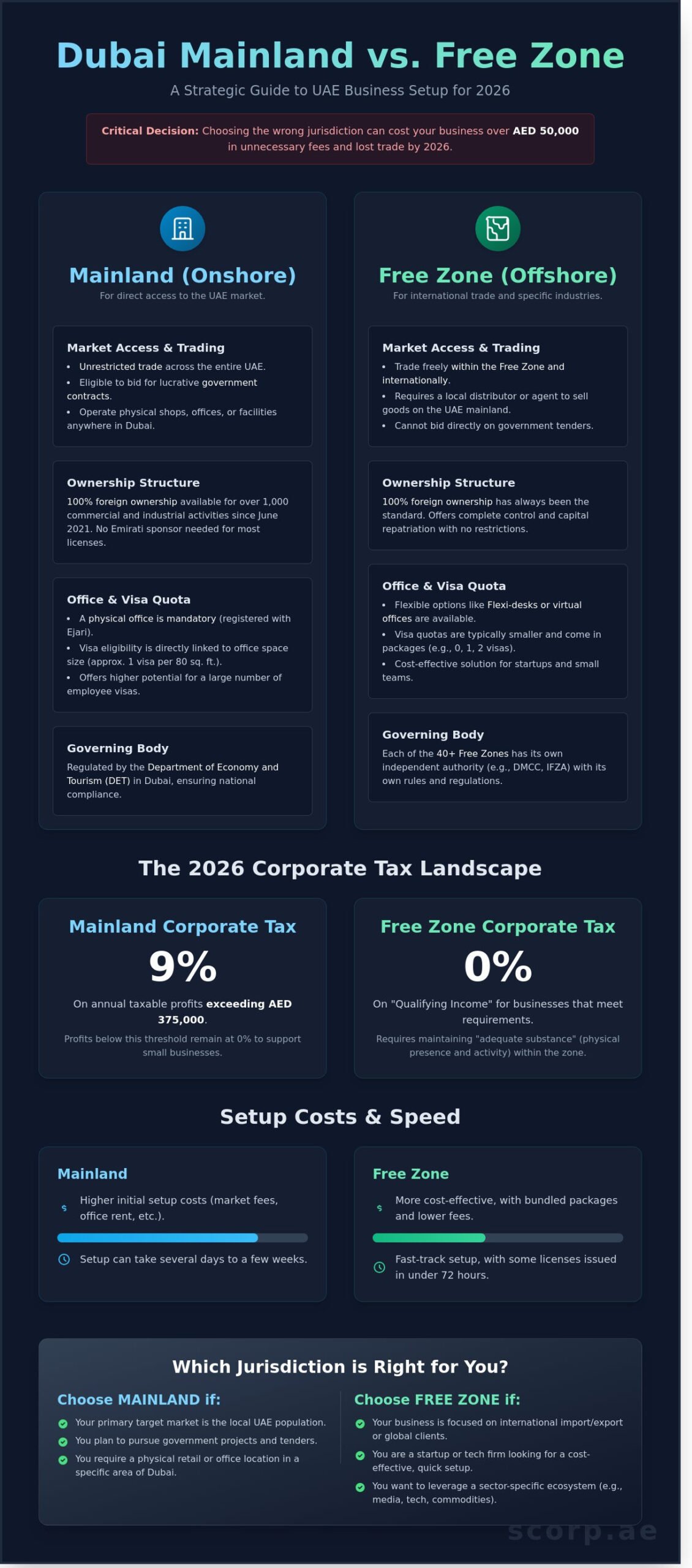
Choosing the wrong Dubai jurisdiction can cost your business over AED 50,000 in unnecessary fees and lost trade by 2026. You likely know the UAE offers incredible growth, but the choice between territories often feels like a high-stakes gamble. It’s common to feel overwhelmed by shifting ownership rules and the fear of hidden costs during your first renewal. Understanding the dubai mainland vs free zone pros and cons is the only way to protect your investment and ensure long-term success.
We provide a clear, professional roadmap to help you choose the perfect foundation for your entrepreneurial journey. You’ll discover the critical differences in trading rights, visa quotas, and office space requirements for the 2026 market. This guide compares setup costs and operational limits to ensure your business thrives without any administrative friction. We’ll preview the essential steps to streamline your setup with an end-to-end solution that turns your vision into a reality today.
Key Takeaways
- Understand the fundamental differences between onshore Mainland entities and offshore Free Zones to build a solid business foundation.
- Evaluate the dubai mainland vs free zone pros and cons to determine which jurisdiction offers the best geographic flexibility.
- Learn how office requirements like Ejari or Flexi-desks directly impact your visa quota and your scaling potential.
- Use our strategic framework to align your business setup with your target market, whether local or global.
- Discover how to simplify your setup with transparent pricing and end-to-end solutions for a seamless launch.
Understanding the Basics: What is Dubai Mainland vs Free Zone?
Dubai offers a world-class environment for your business dreams. Your first step involves choosing between a Mainland and a Free Zone setup. A Mainland entity is an “onshore” company. The Department of Economy and Tourism (DET) regulates these businesses. They allow you to trade directly with the local UAE market without restrictions. You can also bid for lucrative government contracts and set up physical offices anywhere in the city. This flexibility makes it the preferred choice for retail, construction, and specialized services.
Free Zones are “offshore” economic areas designed for specific industries. Each zone acts as an independent jurisdiction with its own rules. These areas function as international trade hubs. They offer incredible benefits like 100% import and export tax exemptions. However, Free Zone companies usually trade within their zone or internationally. If they want to sell goods on the UAE mainland, they must use a distributor or a local agent. Comparing the dubai mainland vs free zone pros and cons helps you decide which path fits your long-term goals.
The core philosophy differs for each setup. Mainland focuses on local market integration and national reach. Free Zones focus on sector-specific clusters and global trade efficiency. By 2026, the UAE will be the most accessible market for global investors. Both jurisdictions now offer 100% foreign ownership for over 1,000 commercial and industrial activities. This landmark change removes the old barriers that once limited international entrepreneurs.
The Evolution of UAE Business Jurisdictions
The UAE government transformed the business landscape on June 1, 2021. Federal Decree-Law No. 26 of 2020 changed the Commercial Companies Law significantly. It removed the requirement for a 51% Emirati partner in most sectors. Now, you can own your mainland business entirely. The role of a local service agent (LSA) replaced the old partner model for professional licenses. This agent handles administrative tasks but holds no equity in your company. These updates make 2026 a prime year for your expansion into the region.
Key Regulatory Bodies You Need to Know
The DET manages all Mainland licenses in Dubai. They ensure your business follows national standards and legal frameworks. In contrast, Free Zone Authorities act as independent regulators within their borders. Examples include IFZA for creative startups or DMCC for commodities trading. There are over 40 free-trade zones in the United Arab Emirates today. Each authority provides its own visas, office spaces, and licensing procedures. Choosing the right authority determines your operational ease and costs.
Our team at Sarsan Corporate Services provides end-to-end solutions for these complex decisions. We streamline the process to ensure your setup is hassle-free. You can get a clear picture of the dubai mainland vs free zone pros and cons by looking at your specific business activity. Whether you need a Mainland trade license or a Free Zone visa, we handle the paperwork. This allows you to focus on your growth while we manage the regulatory hurdles. Our expertise ensures a seamless transition into the vibrant Dubai market.
Dubai Mainland vs Free Zone: Pros and Cons Comparison
Choosing the right legal structure is the most critical decision for your UAE venture. Your choice dictates where you can trade, how much tax you pay, and your total setup costs. Understanding the dubai mainland vs free zone pros and cons helps you align your license with your long-term commercial goals. Mainland companies register with the Department of Economy and Tourism (DET). Free Zone entities operate within specific jurisdictions, each with its own set of rules.
Mainland setups offer unmatched geographic flexibility. You can lease office space anywhere in Dubai, from Downtown to Jumeirah. This allows your team to work closer to clients or talent hubs. Mainland businesses also have the right to bid for government tenders and contracts. These projects provide a level of prestige and financial stability that Free Zone companies often miss. However, the initial costs are higher. You should expect to pay more for trade name approvals, market fees, and mandatory physical office space.
Free Zones provide a streamlined, cost-effective alternative for startups and tech firms. These zones offer sector-specific ecosystems like Dubai Media City or Dubai Internet City. You benefit from being surrounded by similar businesses and specialized infrastructure. The setup process is remarkably fast; many entrepreneurs receive their licenses in under 72 hours. While Free Zones allow 100% foreign ownership, they restrict your physical operations to the zone’s boundaries. You cannot open a retail shop or a physical office in a mainland mall with a Free Zone license alone.
The 2026 Tax Landscape: Corporate Tax and VAT
The UAE introduced a federal corporate tax in June 2023. Mainland businesses pay a 9% tax rate on all annual taxable profits that exceed AED 375,000. Profits below this threshold remain at 0% to support small business growth. This makes the mainland an attractive option for growing companies that value local market access over total tax exemption.
Free Zone entities can still enjoy a 0% tax rate on “Qualifying Income” to remain competitive. To benefit, the company must maintain “adequate substance” within the zone. This means you must have enough employees and assets located physically in the Free Zone. A Qualifying Person is a Free Zone entity that maintains adequate substance and complies with all transfer pricing rules under the latest 2026 Ministry of Finance guidelines.
Market Access and Trading Restrictions
Mainland companies enjoy total freedom to trade across all seven emirates. You don’t need a distributor or a middleman to sell your products in Abu Dhabi or Sharjah. This direct access simplifies your supply chain and protects your profit margins. If you plan to open multiple branches across the country, a mainland license is the only logical choice. You can scale your operations without hitting regulatory walls.
Free Zone companies face strict barriers when selling to the local UAE market. To sell goods outside the zone, you must use a local distributor or a clearing agent. This usually involves paying a 5% customs duty on your products. For many, “dual licensing” offers a modern solution. This allows a Free Zone company to apply for an additional mainland license without needing extra office space. If you feel overwhelmed by these choices, seeking expert business setup guidance can clarify your path forward.
- Mainland: Best for retail, construction, and government-focused services.
- Free Zone: Best for e-commerce, consultancy, and international trading.
- Dual License: A hybrid model for businesses needing both zone benefits and local reach.
Operational Requirements: Visas, Office Space, and Costs
Every entrepreneur faces a critical choice between physical presence and upfront cost efficiency. Understanding the dubai mainland vs free zone pros and cons helps you allocate your capital wisely from day one. Operational costs extend far beyond the initial license fee. You must account for registration, mandatory health insurance, and annual renewals to keep your business compliant.
On the mainland, initial license costs typically range from AED 18,500 to AED 25,000. Free zones like RAKEZ or IFZA offer competitive packages starting as low as AED 12,500 for a zero-visa setup. You also need to factor in mandatory health insurance for all employees. Basic plans start at approximately AED 600 per year per person. Navigating these variables requires precision. Utilizing professional Dubai business setup services ensures you avoid hidden fees and streamline the registration process.
Total setup costs often include these components:
- Trade License Fee: Paid annually to the Department of Economy and Tourism (DET) or the specific Free Zone Authority.
- Voucher Fees: One-time payments for name reservation and initial approval.
- Establishment Card: Costs roughly AED 2,000 to AED 5,000 and allows the company to recruit staff.
- E-Channel Registration: A mandatory fee for free zone companies to access the immigration portal.
Office Space and Ejari Requirements
Mainland companies must secure a physical office with a verified Ejari lease contract. This document is a mandatory requirement for your trade license issuance. Most mainland activities require a minimum of 200 square feet of dedicated space. Free zones offer significantly more flexibility through “smart desks” or flexi-desks. These options provide a legal business address without the high overhead of a private suite. Your office size directly dictates your visa quota. In most jurisdictions, you receive one visa allocation for every 9 square meters of office space. Choosing a flexi-desk usually limits you to two or three visas total.
Visa Processing and Residency for Founders
Obtaining a residency visa usually takes 10 to 15 working days once your license is active. Free zones utilize e-channel services to accelerate entry permits and status adjustments. This digital system requires a one-time registration fee between AED 2,200 and AED 5,000. Family sponsorship rules are consistent across both jurisdictions. You need a minimum monthly salary of AED 4,000 or AED 3,000 plus company-provided accommodation to sponsor dependents. Mainland setups offer more freedom for staff to work at various client sites across the UAE. Free zone employees are technically restricted to working within the zone’s boundaries. Carefully balancing the dubai mainland vs free zone pros and cons ensures your team has the mobility they need to succeed.
The visa process follows a strict timeline:
- Entry Permit: Issued within 3 to 5 business days.
- Medical Test and Emirates ID Biometrics: Completed within 48 hours of arrival or status change.
- Visa Stamping/Approval: Finalized within 7 working days after the medical results.
Sarsan Corporate Services provides end-to-end solutions to manage these timelines. We handle the paperwork so you can focus on your core business operations. Our experts ensure your office lease and visa applications meet all current UAE regulations without delay.
Which One Should You Choose? A Decision Framework
Selecting the right structure requires a logical approach tailored to your specific goals. You must weigh the dubai mainland vs free zone pros and cons based on your operational needs and long-term vision. Use this five-step framework to find your ideal fit.
- Step 1: Identify your primary target market. If you intend to trade directly with local UAE consumers or provide services to government entities, mainland is the standard choice. Free Zones are perfect for businesses focusing on international markets or specific specialized hubs.
- Step 2: Check your activity requirements. Professional services like consulting work well in both setups. However, industrial activities involving heavy manufacturing often require a mainland licence to access local infrastructure and transport networks without additional customs barriers.
- Step 3: Calculate staffing and visa needs. Mainland companies can scale their workforce based on the size of their physical office. Free Zones typically offer fixed visa quotas, such as 2 or 3 visas for a flexi-desk setup. Expanding beyond this often requires upgrading to a larger, more expensive office within the zone.
- Step 4: Evaluate retail and tender needs. Do you need a physical shop in a popular mall? Mainland is your only option. If you want to bid for government contracts, which saw a 12 percent increase in value in 2023, you need a Department of Economy and Tourism (DET) licence.
- Step 5: Compare the three-year Total Cost of Ownership (TCO). A Free Zone setup might start at AED 12,500, but renewal fees and visa costs can add up. Mainland licences often have higher initial costs but can prove more economical as you scale your team and operations.
Industry-Specific Recommendations
Tech startups and freelancers often thrive in Free Zones like Dubai Internet City or Dtec. These hubs provide 100 percent foreign ownership and vibrant networking ecosystems. In contrast, construction, retail, and logistics firms almost always require a mainland licence. You need this to move goods freely across the Emirates and lease physical storefronts. For e-commerce entrepreneurs, specialized hubs like Dubai CommerCity will remain the top choice through 2026. They offer dedicated fulfillment centers and streamlined customs processes that make shipping effortless.
Scalability and Future-Proofing Your Business
You cannot simply move a licence from a Free Zone to the Mainland later. It usually requires closing one company and starting a new one. This makes your initial choice vital for long-term success. Opening a corporate bank account is often faster for mainland companies. UAE banks frequently view mainland entities as more established due to their physical presence requirements. If you plan to expand into the wider GCC region, a mainland setup provides a more recognized corporate structure for cross-border trade.
Our team provides end-to-end solutions to ensure your setup is handled with expert care. We simplify the complexities of the dubai mainland vs free zone pros and cons so you can focus on growth.
Ready to launch your venture? Get your tailored business setup quote in 30 seconds and start your journey today.
Choosing the right path doesn’t have to be stressful. By following a structured framework, you ensure your business remains compliant and ready for the future. Sarsan Corporate Services acts as your trusted partner, providing a seamless process from initial application to residency visa stamping. We turn your entrepreneurial aspirations into a reality with hassle-free support at every stage.
How Sarsan Corporate Services Simplifies Your Setup
Deciding between a mainland company and a free zone entity involves more than just picking a location. It requires a deep understanding of the dubai mainland vs free zone pros and cons to ensure your business structure supports your long-term goals. Sarsan Corporate Services provides end-to-end solutions that remove the guesswork from this complex decision. We handle every detail of the incorporation process; from initial name reservation to final visa stamping. Our team ensures you don’t waste time on administrative loops or incorrect filings.
We prioritize transparent pricing so you can budget with total confidence. You won’t find hidden fees or surprise “service charges” halfway through your application. We provide a clear breakdown of government costs in UAE Dirhams (AED) and our professional fees upfront. This honesty builds the foundation of our role as your trusted partner. Our goal is to make the journey hassle-free so you can focus on your market entry strategy rather than paperwork. We treat your business as our own and guide you toward the most cost-effective jurisdiction for your specific activity.
Our Seamless 3-Step Formation Process
Our methodology is designed for speed and accuracy. First, we conduct a detailed initial consultation to match your business goals with the right jurisdiction. We analyze your target market and ownership requirements to recommend either a Mainland or Free Zone setup. This step ensures you don’t choose a restrictive license that hinders your growth later. We look at your five-year plan to ensure the foundation is solid from day one.
Second, we manage all document preparation and submission to the relevant UAE authorities. Whether you’re dealing with the Department of Economy and Tourism (DET) for a mainland license or a specific Free Zone authority like IFZA or DMCC, we handle the interface. We draft the Memorandum of Association and ensure all signatures meet legal standards. This stage eliminates the risk of rejection due to minor clerical errors or missing certifications.
Third, we oversee the final delivery of your trade license and provide comprehensive residency visa support. We coordinate your medical tests and Emirates ID biometrics to make the process move quickly. You’ll receive a complete corporate kit ready for bank account opening. Our team stays by your side until your business is fully operational and legally compliant.
Ongoing Support and Compliance
Our relationship doesn’t end once you receive your license. We provide essential assistance with VAT registration and Corporate Tax compliance to keep your business in good standing. With the UAE’s 9% Corporate Tax on profits exceeding AED 375,000, professional guidance is now more important than ever. We help you navigate these regulations to avoid costly penalties and ensure your books are audit-ready. Our experts monitor legislative changes so you don’t have to track them yourself.
We also offer proactive renewal services for your trade license and establishment cards. Missing a renewal date can result in fines starting from AED 200 per month or even the suspension of your business activities. We track these deadlines for you and manage the entire renewal cycle months in advance. Sarsan has helped over 5,000 entrepreneurs since the group’s inception in 1982. If you’re ready to start your journey, please contact us for a tailored consultation today.
Launch Your UAE Venture With Confidence
Understanding the dubai mainland vs free zone pros and cons is the first step toward a successful 2026 launch. Mainland companies offer the flexibility to trade anywhere in the UAE and win government contracts. Free zones provide a streamlined path with 100% foreign ownership and access to over 40 specialized jurisdictions. Your decision should align with your long-term growth and physical office needs.
We offer expert guidance across 40+ UAE free zones to find the perfect fit for your brand. Our team provides transparent pricing with no hidden costs; this ensures you stay on budget from day one. We provide end-to-end solutions to make your setup effortless and professional.
Start your hassle-free Dubai business journey with Sarsan today!
You’re ready to build something great in the UAE. We’re here to turn your vision into a reality.