





















What if you could legally eliminate your corporate tax while securing your global assets behind a world-class legal fortress? You likely find the distinction between Free Zone and offshore entities confusing, especially with the 2023 UBO reporting requirements. Many entrepreneurs fear that an offshore company structure in UAE leads to endless banking hurdles or compliance traps.
You’ll learn how to optimize your international business and protect your capital using a secure UAE offshore framework. Our team provides end-to-end solutions to ensure your setup remains seamless and fully compliant with the latest 2026 regulations. We’ll walk you through the benefits of RAKICC and JAFZA jurisdictions. You’ll also learn the steps for corporate account approval and how to maintain 100% foreign ownership. This guide provides the clarity you need to transform your entrepreneurial aspirations into a profitable reality.
Key Takeaways
- Protect your international assets and optimize trade by establishing a secure legal entity in a UAE tax-free zone.
- Compare RAK ICC and JAFZA jurisdictions to find the perfect fit for your global business or Dubai property investments.
- Identify the ideal offshore company structure in UAE by understanding how it differs from a traditional free zone setup.
- Simplify your journey with a clear five-step registration process that covers everything from name approval to final filing.
- Gain peace of mind with end-to-end solutions that handle all complex paperwork so you can focus on business growth.
What is an Offshore Company Structure in the UAE?
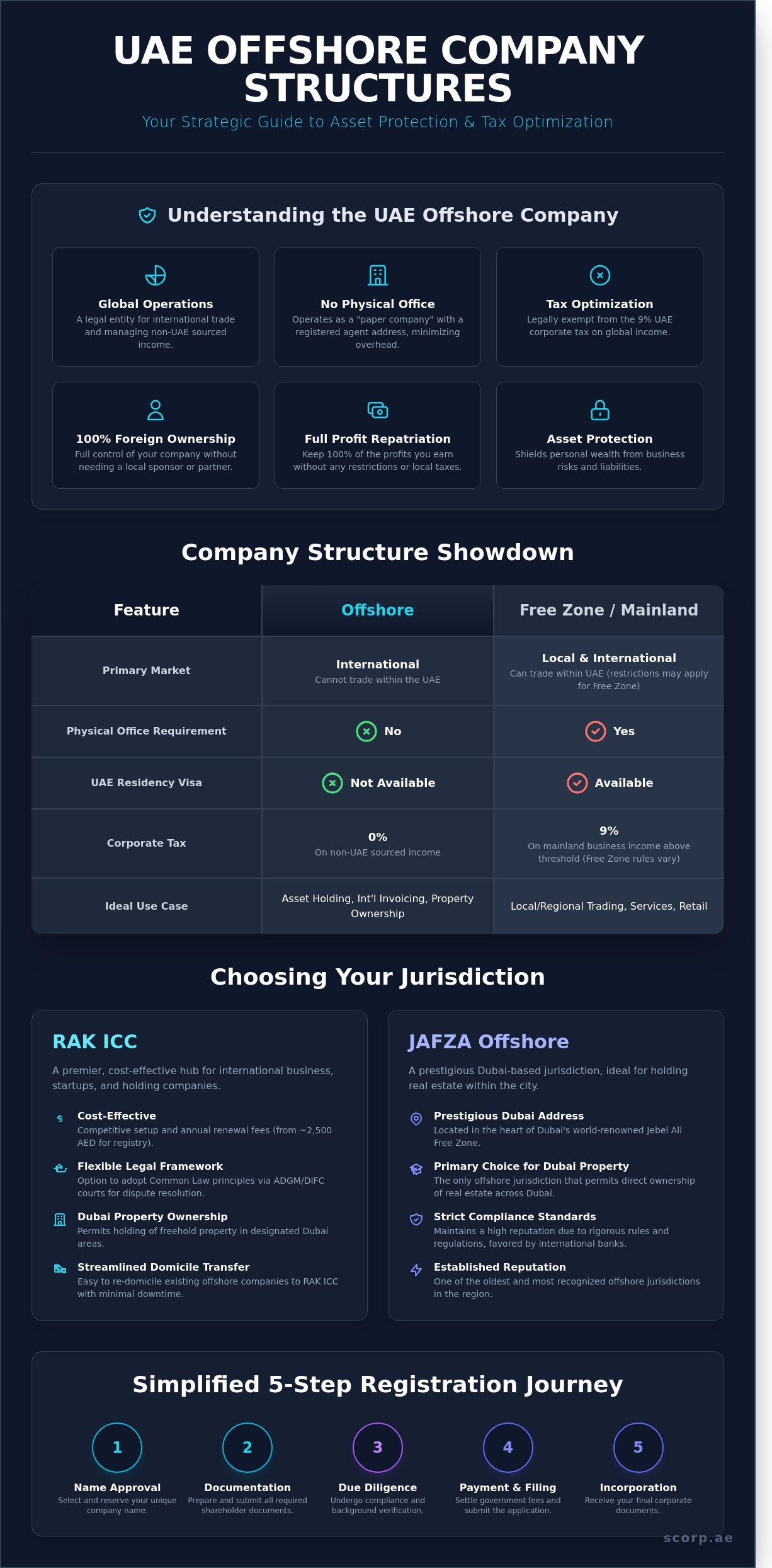
An offshore company is a legal entity registered within specific UAE jurisdictions like Jebel Ali Free Zone (JAFZA) or RAK International Corporate Centre (RAKICC). These entities operate under a unique legal framework that allows for tax-free operations on global income. Unlike other business types, an offshore company structure in UAE doesn’t require a physical office space. You simply need a registered agent to handle the paperwork and provide a legal address. This setup streamlines the process for international investors who want a secure base in the Middle East without the overhead of local operations.
The legal framework follows United Arab Emirates corporate law, which ensures transparency and security for all stakeholders. Since the introduction of the 9% corporate tax on mainland businesses in June 2023, offshore entities remain a vital tool for tax optimization on non-UAE sourced income. Over 30,000 companies currently use RAKICC for this purpose because it offers a stable and confidential environment. These structures are ideal for managing international trade while benefiting from the country’s strong banking sector and reputable international standing.
Setting up an offshore entity is an efficient way to manage your international interests. These companies are often called “paper companies” because they lack a physical footprint in the UAE. You don’t need to rent a warehouse or an office suite. This reduces your overhead costs significantly. You only need a registered address provided by a licensed agent like Sarsan Corporate Services. This setup is ideal for those who manage businesses remotely and don’t require local staff or physical distribution centers within the Emirates.
The Purpose of an Offshore Entity
Asset protection is the primary driver for international investors. By holding assets through an offshore entity, you shield your personal wealth from business risks. These structures often act as holding companies for real estate in the UAE. For example, RAKICC companies can own freehold property in specific areas of Dubai. You enjoy 100% foreign ownership and full profit repatriation. This means you keep every dirham you earn without sharing equity with a local sponsor.
Offshore vs. Mainland: Key Differences
Mainland companies must lease physical office space and can trade anywhere in the UAE. In contrast, offshore companies don’t have this requirement or right. They can’t conduct business directly with residents or companies within the UAE local market. Another vital distinction involves residency. While mainland and free zone setups grant residency permits, an offshore company structure in UAE doesn’t provide UAE residency visas for owners or employees. It’s strictly a corporate vehicle for global operations.
Sarsan Corporate Services has helped entrepreneurs set foot in the UAE. We provide end-to-end solutions to make your setup journey seamless and efficient. Our team ensures your company meets all regulatory requirements without any hidden costs. We act as your trusted partner to transform your business goals into reality. Whether you need a holding company or a vehicle for international trade, we streamline the entire process. Our experts handle the complex documentation while you focus on your growth strategy.
Choosing the right jurisdiction is crucial for your long-term success. We offer tailored advice to ensure your company meets your specific needs. Our relationship doesn’t end after the setup. We provide ongoing support to help your business thrive in the global market. You can start your journey with confidence knowing that our experienced guides are with you every step of the way. We make the registration process hassle-free and transparent for every client.
Choosing the Right Jurisdiction: RAK ICC vs. JAFZA
Selecting the ideal location defines your offshore company structure in UAE. Both Ras Al Khaimah International Corporate Centre (RAK ICC) and Jebel Ali Free Zone (JAFZA) offer 100% foreign ownership. They ensure high levels of confidentiality for shareholders. However, their specific applications for asset holding and property ownership differ significantly. You must choose based on your specific business goals and budget.
RAK International Corporate Centre (RAK ICC)
RAK ICC serves as a premier hub for international business and global investment. It’s a cost-effective choice for entrepreneurs launching startups or managing holding companies. You’ll find that annual renewal fees remain competitive. These fees often start around 2,500 AED for the registry renewal alone. This jurisdiction follows a flexible legal framework. It allows companies to adopt Common Law principles for dispute resolution through the ADGM or DIFC courts. This provides investors with a familiar legal environment for complex contracts.
If you already own an offshore entity elsewhere, RAK ICC makes the transition simple. The process to transfer a domicile is streamlined and requires minimal downtime. This flexibility attracts thousands of companies to the registry every year. It’s an efficient way to protect global assets without the high overhead of a physical office. Startups benefit from the lack of paid-up capital requirements. This allows you to scale your business at your own pace without locking up significant liquidity.
Jebel Ali Free Zone (JAFZA) Offshore
JAFZA offers a prestigious address in the heart of Dubai. It’s the only offshore jurisdiction that permits the ownership of real estate within Dubai. If your goal is to hold property assets in the city, you must follow specific JAFZA rules and regulations regarding registration. This authority maintains strict compliance standards to ensure every entity meets international transparency benchmarks. This prestige makes JAFZA a preferred choice for high-net-worth individuals and institutional investors.
Setup costs in JAFZA are typically higher than in RAK ICC. Initial registration often exceeds 10,000 AED. Many investors find this price justifiable because of the direct access to Dubai’s property market. It provides a secure vehicle for managing high-value portfolios. You get the benefit of a world-class reputation and proximity to major logistics hubs. JAFZA companies must appoint an approved registered agent to handle all filings and maintain the company’s legal standing.
Both jurisdictions provide high levels of asset security and privacy. They don’t require a physical office space or a local sponsor. You can manage your business entirely from abroad. While RAK ICC focuses on international trade and ease of entry, JAFZA prioritizes local asset integration and regional prestige.
Consider these key differences for your offshore company structure in UAE:
- RAK ICC: Best for international trading, holding shares in foreign companies, and cost-sensitive startups.
- JAFZA: Essential for holding Dubai-based real estate and projects requiring a Dubai-specific corporate identity.
- Confidentiality: Both registries keep shareholder details private from public records to ensure security.
- Compliance: Both require annual audited financial statements in certain scenarios to maintain their license.
Choosing between them depends on your long-term goals. Do you need a cost-effective holding company or a vehicle for Dubai real estate? Our team can help you evaluate your specific business needs to find the perfect fit. We focus on providing a seamless experience for every client from start to finish.
Offshore vs. Free Zone: Which Structure Fits Your Goals?
Choosing the right business setup requires a clear understanding of your long-term objectives. The offshore company structure in UAE serves a very different purpose than a free zone entity. You must decide if you need a physical presence or just a legal gateway for international trade. Free zones act as resident entities, while offshore companies remain non-resident. This distinction affects everything from your tax status to your ability to hire staff.
A free zone company allows you to conduct business within the UAE and internationally. It provides a platform for entrepreneurs who want to establish a deep-rooted presence in Dubai. In contrast, an offshore setup is strictly for business activities outside the country. It’s a specialized tool for holding assets or managing global trade with minimal local footprints. Your decision will impact your costs, your visa eligibility, and your daily operations.
When to Choose a Free Zone Company
You should choose a free zone structure if you plan to live and work in the UAE. This setup is the primary route for obtaining a UAE residency visa for yourself and your family. Most free zones require you to rent a physical office or a flexi-desk. These office solutions often start at approximately AED 15,000 per year. This physical base allows you to open a corporate bank account with local banks more easily. If you need comprehensive support for this process, you can explore Dubai business setup services to find a tailored solution.
Free zone entities are ideal for startups that need a local team. You can hire employees and issue them work permits under your license. This structure also grants you 100% foreign ownership and full repatriation of capital. It’s a robust choice for consultancy firms, retail brands, and service providers who want to tap into the regional market. While the setup costs are higher than offshore options, the benefits of residency and local operation often justify the investment.
When to Choose an Offshore Structure
An offshore company structure in UAE is the best fit for those who only need a corporate vehicle for international activities. You don’t need a physical office in the UAE. Instead, your company uses the address of a registered agent. This significantly reduces your annual overhead. Setup is incredibly fast; many entrepreneurs receive their incorporation documents within 48 to 72 hours. This speed makes it a favorite for investors who need to move quickly on international deals.
Offshore companies offer high levels of privacy and low maintenance requirements. Most jurisdictions don’t require an annual audit, which saves you thousands of dirhams in accounting fees. If you’re looking for a jurisdiction with a strong reputation, Jebel Ali is a top contender. You can review the JAFZA Offshore Company Regulations to understand the specific legal framework governing these entities. It’s a perfect structure for holding shares in other companies or owning global real estate assets.
Consider these key differences before you commit:
- Residency: Free zones offer visas; offshore companies don’t.
- Physical Office: Free zones require a desk or office; offshore companies use a registered agent.
- Local Trade: Free zones can trade in the UAE via a distributor; offshore companies cannot.
- Audit Requirements: Free zones usually require audits; many offshore types don’t.
- Setup Speed: Offshore setups are generally faster and involve less paperwork.
Sarsan Corporate Services provides end-to-end solutions for both paths. We simplify the complexity of UAE regulations to ensure your business starts on a solid foundation. Whether you need a physical office in a bustling free zone or a discreet offshore gateway, we handle the process with professional expertise. Our goal is to make your business setup effortless so you can focus on growth.
How to Set Up Your Offshore Structure in 5 Steps
Establishing a robust offshore company structure in UAE helps protect your global assets while optimizing your tax profile. The process is efficient and logical when you follow the right sequence. You’ll find that the UAE authorities have streamlined these requirements to support international investors who value speed and transparency.
1. You must first select a licensed registered agent like Sarsan Corporate Services to handle your filing. UAE law for jurisdictions like RAK ICC and JAFZA prohibits individuals from submitting applications directly to the registrar. Your agent acts as a professional bridge, managing all legal correspondence and ensuring your documents meet the latest 2024 regulatory standards. This partnership simplifies the entire journey and prevents common administrative delays.
2. Choosing three unique names for your company is the second critical step. The registrar requires a list of options in order of your preference. You should avoid restricted terms like “Charity,” “Insurance,” or “Trust” unless you have specific prior approval. Most approvals for a name reservation occur within 24 hours, provided the names don’t conflict with existing trade names in the UAE registry.
3. Gathering your core documentation is the third phase. You’ll need high-resolution passport copies and a bank reference letter for every shareholder involved. These documents verify your financial standing and identity for the registrar’s compliance department. Sarsan Corporate Services reviews these files before submission to ensure they are complete and accurate.
4. The fourth step involves drafting the Memorandum and Articles of Association (MOA). This legal document defines how you’ll govern the entity and outlines the specific powers of your directors. It serves as the foundational constitution for your offshore company structure in UAE. Your agent ensures the MOA reflects your specific business goals while remaining compliant with local corporate laws.
5. Finally, you’ll receive your certificate of incorporation. This usually takes between 3 to 7 working days after the final submission. Once you hold this certificate, your corporate operations can officially begin. You can then proceed to open a corporate bank account and manage your international investments with confidence.
Required Documentation for 2026
For 2026, the registrar requires a specific set of Know Your Customer (KYC) documents to maintain high compliance standards. You must provide a utility bill or a bank statement issued within the last 90 days as proof of residence. Shareholders must also submit a professional curriculum vitae (CV) that highlights their business background. Providing a clear business plan is now mandatory because it helps the registrar understand your expected cash flow and target markets. All documents must be in English or include an official legal translation from a certified UAE translator.
Compliance: UBO and ESR Regulations
The UAE Cabinet Decision No. 58 of 2020 requires all entities to report their Ultimate Beneficial Ownership (UBO). You must identify any individual who owns or controls 25% or more of the company’s shares. This reporting ensures the UAE remains a transparent and trusted financial hub. Economic Substance Regulations (ESR) also apply if your offshore entity performs “Relevant Activities” like holding company functions or shipping. ESR is a rule to ensure companies have real activity. Failing to file annual ESR notifications can result in penalties starting from AED 20,000 for the first instance of non-compliance.
Ready to secure your international assets with a professional setup? Contact Sarsan Corporate Services today for a seamless incorporation experience.
Seamless Offshore Formation with Sarsan Corporate Services
Establishing an offshore company structure in UAE requires more than just filling out standard forms. It demands a strategic partner who understands local regulations and international compliance standards. Sarsan Corporate Services provides end-to-end solutions that manage every aspect of your business setup. We handle the heavy lifting of administrative tasks so you can focus 100 percent of your energy on scaling your operations. Our team manages the entire paperwork trail to ensure your registration remains fast and accurate.
We believe that clarity is the foundation of a successful business relationship. For 2026, we maintain a policy of complete transparency regarding our service costs. You won’t find hidden fees or unexpected charges in our service agreements. We provide detailed quotes in AED so you can budget with total confidence. Most clients receive a quick business setup quotation in under 30 seconds through our digital platform. This efficiency defines our approach to modern corporate services.
- Full Documentation Support: We prepare your Memorandum of Association and all necessary registration certificates.
- Bank Account Assistance: Our experts guide you through the requirements for opening corporate accounts in the UAE.
- Regulatory Compliance: We ensure your offshore company structure in UAE meets all current legal mandates.
- Fast-Track Processing: We utilize our established networks to speed up approvals from relevant government authorities.
Our commitment to your success extends far beyond the initial setup phase. We stay by your side for annual license renewals and essential compliance filings. We handle Economic Substance Regulations (ESR) notifications and Ultimate Beneficial Ownership (UBO) registers to keep your company in good standing. This ongoing support prevents the 15 percent budget overruns that often occur due to late filing penalties or administrative errors.
Start Your Journey Today
Your entrepreneurial goals are within reach with the right guidance. Don’t let the complexity of international regulations hold you back from your next big move. You can contact us today to receive a personalized quote for your offshore setup. Our team is ready to transform your aspirations into a functional corporate reality. Book a consultation with our experienced corporate advisors to begin your success story in the United Arab Emirates. We are ready to help you thrive in one of the world’s most dynamic business hubs.
Launch Your Global Business Strategy Today
Establishing a robust offshore company structure in UAE provides your business with a powerful gateway to international markets. Choosing between RAK ICC and JAFZA depends on your specific goals for asset protection or property holding. We ensure your setup follows the latest 2026 compliance standards without any hidden fees. It’s vital to have a partner who understands the nuances of local laws.
Frequently Asked Questions
Can a foreigner own 100% of a business in the UAE in 2026?
No, an offshore company structure in UAE cannot trade directly within the local UAE market. These entities must conduct business activities outside the country’s borders. You can, however, own shares in local companies or hold real estate in specific areas like Dubai Marina. If you need to trade locally, a Mainland or Free Zone setup is the right choice. We help you choose the best path for your success.
Do I get a residency visa with an offshore company structure?
You don’t receive a UAE residency visa with an offshore company setup. This structure is designed for asset protection and international tax planning rather than physical residency. If your goal is to live and work in Dubai, you should consider a Free Zone or Mainland license instead. These options provide 3-year renewable visas for investors. We handle all the paperwork to make your transition effortless.
How much does it cost to set up an offshore company in UAE in 2026?
Setting up an offshore company in 2026 typically costs between AED 8,000 and AED 15,000. This estimate includes registration fees, first-year registered agent fees, and government charges. Prices vary depending on whether you choose RAK ICC or JAFZA. You should also budget approximately AED 2,500 for annual renewal and compliance costs to keep your entity active. Our transparent pricing ensures there are no hidden costs for your business.
Can an offshore company open a corporate bank account in Dubai?
Yes, an offshore company can open a corporate bank account in Dubai, though the process is rigorous. Banks require a minimum balance often starting at AED 100,000 for these accounts. You must provide a clear business plan and proof of your source of funds. Our team provides end-to-end solutions to help you navigate these strict compliance requirements. We make the process hassle-free so you can focus on your growth.
Is it mandatory to have a registered agent for offshore setup?
It’s mandatory to appoint a registered agent to incorporate and maintain an offshore entity in the UAE. Authorities like RAK ICC require all official filings and communications to go through a licensed agent. We act as your trusted partner, handling all administrative tasks and ensuring your company remains compliant. This ensures a seamless process for your international operations while you focus on your entrepreneurial aspirations.
What is the difference between RAK ICC and JAFZA offshore?
The main difference lies in cost and property ownership rights. RAK ICC is generally 30% more affordable and offers a faster setup process for international trading. JAFZA is the only offshore jurisdiction that allows you to own property directly in Dubai. Choose JAFZA if you plan to invest in Dubai real estate, or RAK ICC for a more cost-effective offshore company structure in UAE. We provide tailored advice for your specific goals.
How long does the offshore company registration process take?
The registration process for an offshore company usually takes between 2 and 5 working days. This timeline starts once you submit all required documents, such as passport copies and proof of address. We streamline the entire application to ensure you receive your incorporation certificate quickly. Our efficient approach helps you start your international business activities without any delays. This ensures a seamless experience for every entrepreneur we serve.