






















What if your entire UAE property portfolio became a public record and a tax liability because of the 2026 Corporate Tax updates? You likely invested in Dubai or Abu Dhabi real estate to build long term wealth and maintain your family’s privacy. It’s natural to feel concerned about asset seizure or the complex bureaucracy involved in property title transfers. We understand that protecting your hard earned legacy requires more than just a standard purchase agreement.
Our team provides end-to-end solutions to help you implement a robust offshore company structure in UAE and how to manage properties under holding structure under offshore company effectively. You’ll learn how to secure your real estate assets using a professional hierarchy for maximum protection and total regulatory compliance. This guide offers a clear roadmap for your investment journey. We cover everything from privacy strategies to the latest 2026 tax rules to keep your portfolio thriving and secure.
Key Takeaways
- Discover how a dual-layer hierarchy provides maximum protection for your real estate assets through a secure local holding entity.
- Identify the approved jurisdictions and specific Dubai Land Department permissions needed to hold property titles legally and efficiently.
- Explore the offshore company structure in UAE and how to manage properties under holding structure under offshore company for enhanced asset protection.
- Analyze how the 9% Corporate Tax and Economic Substance Regulations affect your international business and property investment returns.
- Follow our end-to-end guide to select the best jurisdiction and complete your setup with a seamless, professional approach.
Understanding UAE Offshore and Holding Company Structures
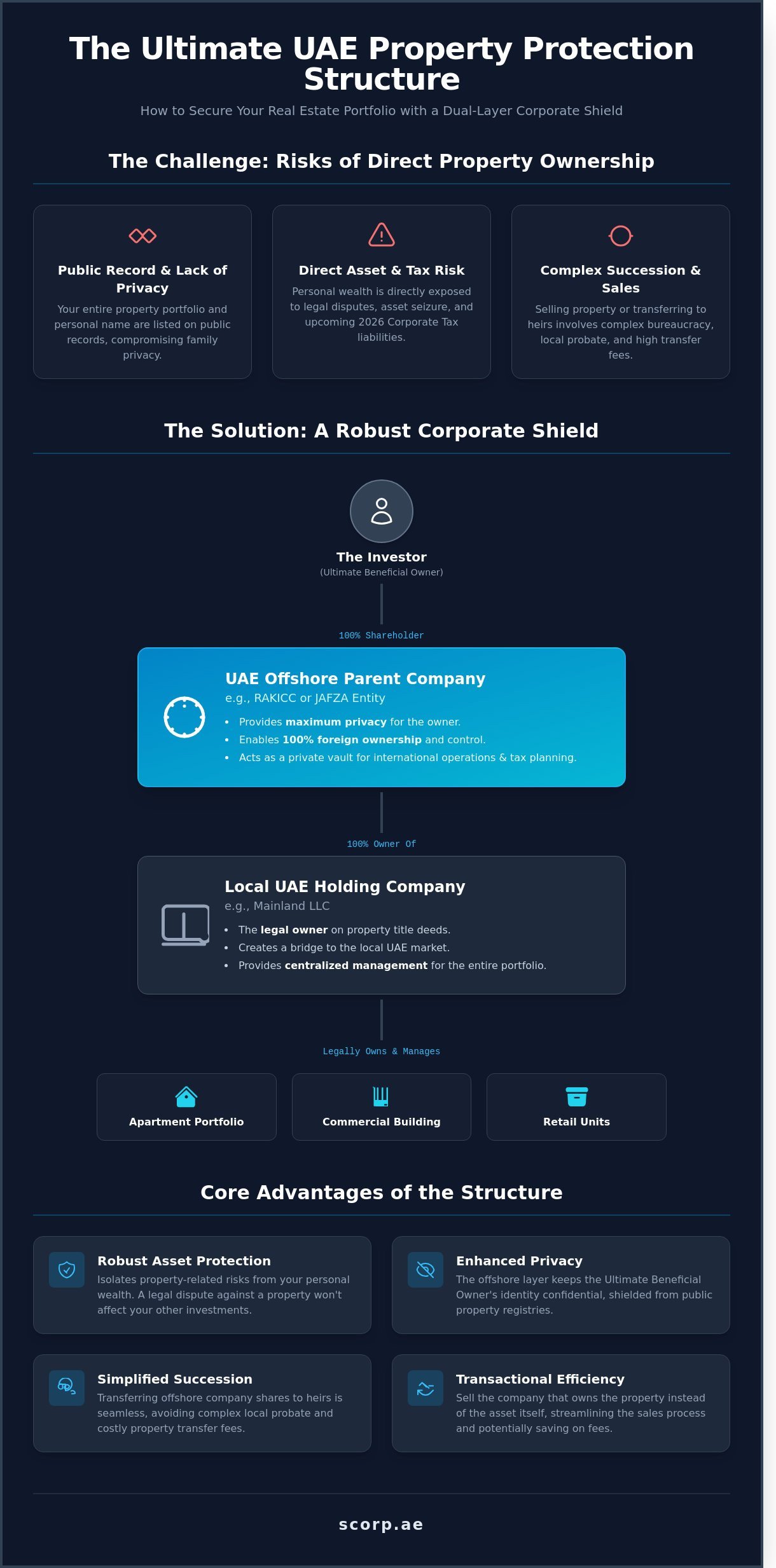
Protecting high-value real estate requires more than just a simple purchase agreement. Smart investors use a multi-layered approach to secure their wealth and ensure privacy. This strategy involves an offshore company and a local holding entity. Learning the offshore company structure in UAE and managing properties under a holding structure system of offshore company is the first step toward long-term asset security. These two entities serve different roles but create a powerful shield when you use them together.
The primary goal of this setup is to separate your personal liability from your property assets. If you own a building in your own name, your personal wealth is at risk during legal disputes. By using a corporate structure, you create a legal barrier. This ensures that any risks associated with the property do not affect your personal bank accounts or other investments. It is a seamless way to manage risk while maintaining full control over your portfolio.
This framework relies on specific UAE corporate law which provides a stable environment for international investors. These regulations allow for flexible ownership models that cater to global business standards. Our team helps you implement an offshore company structure in UAE And how to manage properties under Holding structure under offshore company to ensure your investments remain private and protected.
What is a UAE Offshore Company?
A UAE offshore company is a non-resident legal entity designed for international operations. The two primary jurisdictions for these companies are Jebel Ali Free Zone (JAFZA) and Ras Al Khaimah International Corporate Centre (RAKICC). RAKICC alone hosts over 30,000 companies from 160 countries. These entities cannot conduct business directly within the UAE mainland or rent local office space. They act as a private vault for holding shares in other companies or managing international tax planning. Investors prefer them because they offer 100% foreign ownership and high levels of financial privacy.
The Strategic Role of the UAE Holding Company
A holding company is a vehicle that exists solely to own assets or shares in other firms. In the UAE, this company acts as the legal owner of your real estate. It creates a vital bridge between your offshore parent company and the local property market. If you own five apartments in Dubai, a single holding company can manage them all under one roof. This provides centralized management for your entire portfolio. It simplifies the paperwork for every transaction and makes it easier to track rental income or maintenance costs across multiple units.
Using this dual-layered approach offers several concrete benefits for property owners:
- Asset Protection: It isolates property-related risks from your personal assets.
- Privacy: The offshore layer keeps the identity of the ultimate beneficial owner confidential.
- Succession Planning: It simplifies the transfer of assets to heirs without complex local probate issues.
- Efficiency: You can sell the company that owns the property rather than selling the property itself.
This structure is a tailored solution for those who want a hassle-free experience in the UAE market. It removes the complexity of individual ownership and replaces it with a professional corporate framework. By choosing this path, you transform your property management into a streamlined business operation. We provide the expertise to guide you through every step of this setup. Our goal is to make the process effortless so you can focus on growing your investment success.
The Structural Mechanics: Offshore Parent and Local Holding Entity
The structural mechanics of modern property management rely on a clear two-tier hierarchy. At the summit sits the Offshore Parent Company, which maintains 100% ownership of a local UAE Holding Company, usually falls under Limited Liability Company (LLC), acts as the registered owner on title deeds issued by the Dubai Land Department or relevant emirate authorities. This arrangement creates a robust corporate veil. It ensures that while the local company appears on public records, the ultimate beneficial owner remains shielded behind the offshore registry. This layer of separation is a cornerstone of professional asset management in the region.
Adopting an offshore company structure in UAE and how to manage properties under its structure depends on this specific chain of command. It allows you to add or remove properties from your portfolio without ever altering the parent company. If you decide to sell a specific apartment, you simply transfer the shares of the subsidiary or sell the asset directly from the local holding level. This process eliminates the need to restructure your entire international investment vehicle every time you make a local move. It provides a level of agility that individual ownership simply cannot match.
Why Use an Offshore Entity as the Parent?
Privacy is the most immediate advantage of using an offshore parent. Registries like RAKICC or JAFZA provide high levels of confidentiality for shareholders. This protection is vital for high-net-worth individuals who wish to keep their global footprints private.
Succession planning also becomes significantly more efficient. In the event of an owner’s passing, the shares of the offshore company transfer to heirs according to the company’s articles. This avoids the 4% transfer fee typically charged by the Dubai Land Department for property title changes. Furthermore, this structure offers global flexibility. You can use the same offshore parent to hold international stocks or real estate in other jurisdictions like London or Singapore simultaneously.
Asset Protection and Risk Mitigation
A multi-layered structure effectively isolates your property assets from personal legal disputes or external business failures. By holding real estate through a subsidiary, you ensure that any liability stays confined to that specific entity. Many savvy investors choose to “ring-fence” their assets. This involves placing each high-value property into its own separate subsidiary under the offshore parent. If one property faces a legal claim or a financial shortfall, your other holdings remain untouched and secure.
This professional organization also appeals to institutional lenders. Banks and mortgage providers view corporate holding structures as more stable than individual applications. It demonstrates a commitment to long-term financial planning and transparency. Since the implementation of the UAE Corporate Tax in June 2023, having a formal structure is essential. The law applies a 9% tax on taxable income exceeding 375,000 AED. A holding structure helps you manage these obligations with precision. If you want to protect your wealth, you can consult with our experts to design a tailored holding framework that meets your specific needs. This proactive approach ensures your investments thrive in a regulated environment while maintaining maximum security for your family’s future.
Managing UAE Real Estate Under a Holding Structure
The Dubai Land Department (DLD) maintains strict oversight of all real estate transactions within the emirate. You cannot simply use any global entity to purchase local property. You must use an approved offshore company structure in the UAE. Successfully managing properties under such a holding structure depends entirely on following DLD protocols. The authorities require a clear legal trail to ensure transparency and security for all investors. This setup protects your assets while providing a professional framework for long-term growth.
Permitted Jurisdictions for Property Ownership
The DLD only recognizes specific jurisdictions that have signed a formal Memorandum of Understanding (MoU). Currently, Jebel Ali Free Zone (JAFZA) and Ras Al Khaimah International Corporate Centre (RAKICC) are the most common choices for property holding. These entities have established a seamless legal bridge with the DLD. You’ll need to obtain a No Objection Certificate (NOC) from your chosen jurisdiction before any property purchase. This document confirms your company is active and authorized to hold real estate assets.
Choosing a recognized jurisdiction also simplifies your banking experience. Local banks prefer JAFZA or RAKICC structures because they understand the regulatory compliance involved. You’ll find it much easier to open corporate accounts in AED for your holding company when using these hubs. This reliability is vital for maintaining your property’s financial health and ensuring smooth transactions.
Operational Management and Leasing
Managing your portfolio requires a hands-on approach to administrative tasks. You’ll sign all tenancy contracts through your company’s authorized legal representative. This person is usually the director named in the corporate documents. It’s essential to keep your company license active to avoid any legal hurdles during lease renewals. You must register every rental agreement through the Ejari system to protect your rights as a landlord. This registration provides a legal record of the income and the tenant’s obligations.
Financial compliance is a key part of effectively managing properties under an offshore company holding structure in the UAE. Since June 2023, the UAE Ministry of Finance has introduced federal corporate tax regulations. You should consult with experts to understand how these rules impact your rental yields and corporate filings. Using corporate accounts for maintenance fees and utility payments ensures a clean audit trail. This transparency is necessary if you decide to sell the asset or transfer shares in the future.
Handling these daily tasks can feel overwhelming for international investors. Many owners rely on Dubai business setup services to manage their corporate secretarial needs. These professionals assist with license renewals, NOC applications, and coordinating with the DLD. They ensure your holding structure remains compliant with the latest local laws. This support allows you to focus on your investment strategy while they handle the complex paperwork. A well-managed holding company provides a secure gateway to the thriving Dubai real estate market.
Navigating UAE Corporate Tax and Compliance in 2026
The UAE tax landscape has transformed since the Federal Decree-Law No. 47 took effect on June 1, 2023. By 2026, every investor using an **offshore company structure in UAE and how to manage properties under holding structure **must fully integrate these rules into their strategy. The government applies a 9% corporate tax on taxable profits that exceed AED 375,000. This threshold ensures that smaller startups remain competitive while larger entities contribute to the national economy.
Your offshore entity is a “Taxable Person” if it manages UAE real estate. You must register for Corporate Tax with the Federal Tax Authority (FTA) regardless of your profit levels. Failure to register can lead to a penalty of AED 10,000. By 2026, the FTA will likely increase its focus on historical filings and data accuracy. Maintaining clear digital records for at least seven years is now a vital requirement for every property holding entity.
Corporate Tax Implications for Real Estate
Rental income earned by an offshore company is generally taxable at the 9% rate after the AED 375,000 threshold. You can deduct legitimate business expenses, such as maintenance costs and property management fees, to lower your taxable base. It’s vital to maintain “Substance” to prove your company isn’t just a shell. This involves having adequate personnel and physical presence where decisions happen. For commercial holdings, you must register for VAT if your taxable supplies exceed AED 375,000 annually. Residential leases remain largely exempt from VAT, which simplifies the process for housing investors.
Anti-Abuse Rules and CFC Compliance
The UAE introduced General Anti-Abuse Rules (GAAR) to prevent artificial tax schemes. These rules allow the FTA to disregard transactions that exist solely to gain a tax advantage. If you’re a UAE resident owning an offshore firm, you must watch Controlled Foreign Company (CFC) rules closely. Controlled Foreign Company (CFC) rules are regulations preventing tax evasion by shifting profits to low-tax jurisdictions. Transparency is your best defense against audits in 2026. You should document the commercial reason for every inter-company transfer or loan within your holding structure. Professional record-keeping ensures your property portfolio remains a source of growth rather than a legal burden.
Audit requirements will become more stringent by 2026. Companies with a turnover exceeding AED 50 million must submit audited financial statements. Even if your revenue is lower, a voluntary audit builds trust with banks and local authorities. It proves your offshore company and holding structure management under offshore company follows international best practices. This proactive approach helps you avoid the “Administrative Penalties” that the FTA applies for late or incorrect filings. Our team helps you streamline this documentation so you can focus on acquiring new assets.
Managing these regulations requires a partner who understands the local legal framework. Sarsan Corporate Services provides the comprehensive corporate tax support you need to protect your UAE property investments and ensure long-term success.
Setting Up Your Secure Property Holding Structure
Establishing a robust framework requires a clear roadmap. You must first select an offshore jurisdiction that aligns with your financial goals. RAK International Corporate Centre (RAKICC) and Jebel Ali Free Zone (JAFZA) are the primary choices for investors. JAFZA maintains a direct Memorandum of Understanding with the Dubai Land Department. This makes it a premier choice for holding Dubai real estate. RAKICC offers lower annual maintenance fees, often saving investors over AED 3,500 in yearly costs. Your choice depends on whether you value direct integration or lower overhead expenses.
Once you select the jurisdiction, you begin the incorporation process. You must submit your Memorandum of Association and Articles of Association for official approval. Legalizing these documents is a critical step. It involves attestations from the Ministry of Foreign Affairs and relevant consulates. This process ensures your corporate documents carry legal weight within the UAE. Expect this stage to take between ten to fifteen working days. A complete set of legalized documents allows you to move to the next phase of the setup.
You establish a local UAE holding company as a subsidiary of your offshore parent. This dual-layer approach provides a shield between your personal identity and the real estate asset. It simplifies the transfer of ownership through share transfers rather than physical title deed changes. This method can save you the 4% DLD transfer fee during internal restructures. You then apply for specific DLD approvals to register the property under the corporate name. This step requires a No Objection Certificate (NOC) from the developer and the free zone authority.
Choosing the Right Partners
Setting up these complex layers requires a partner who understands every legal nuance. You need an experienced corporate service provider to manage the end-to-end process. This includes everything from initial name reservation to final DLD registration. We prioritize transparent pricing so you never face unexpected costs during formation. Our team ensures that your offshore company structure in UAE and holding company structure remains compliant with the latest Economic Substance Regulations. We handle the paperwork while you focus on growing your portfolio.
Take the Next Step Toward Asset Security
Building a secure property portfolio starts with the right foundation. A tailored consultation helps you identify the specific needs of your unique investment goals. The right structure today prevents expensive legal headaches and tax complications tomorrow. You deserve a seamless setup process that protects your family’s future wealth. Don’t leave your assets vulnerable to changing regulations or probate delays. Contact Sarsan Corporate Services to start your professional consultation and secure your UAE real estate today.
Secure Your Future with a Robust UAE Property Structure
Protecting your real estate assets requires a strategic approach. By 2026, navigating the 9% corporate tax threshold of 375,000 AED becomes vital for every investor. You can optimize your tax position and ensure seamless succession by using a dual-layer system. This involves an offshore parent company and a local holding entity.
Our team handles the complex paperwork so you can focus on growing your portfolio. Start your hassle-free offshore setup with Sarsan today to transform your property management strategy. It’s the most efficient way to build a lasting legacy in the Emirates. Your path to long-term asset security starts with a single, expert step.
Frequently Asked Questions
Can an offshore company own property in Dubai in 2026?
Yes, a JAFZA offshore company can own freehold property in Dubai in 2026 through a long-standing agreement with the Dubai Land Department. You must register the company specifically for property ownership to hold titles in designated freehold areas like Dubai Marina or Downtown Dubai. This structure provides a seamless way to manage your real estate portfolio while ensuring high levels of privacy and asset protection.
What is the best UAE jurisdiction for an offshore holding company?
Jebel Ali Free Zone (JAFZA) is the premier jurisdiction for an offshore company structure in UAE and how to manage properties under holding structure under offshore company. It’s the only offshore registry that the Dubai Land Department officially recognizes for direct property ownership in the emirate. Alternatively, RAK International Corporate Centre (RAKICC) offers a cost-effective solution for holding shares in other UAE mainland or free zone companies.
Do I need to pay Corporate Tax on rental income from properties held by a company?
You must pay a 9% Corporate Tax on annual net rental income that exceeds AED 375,000. This regulation started on June 1, 2023, for all UAE corporate entities. You can deduct maintenance costs, management fees, and depreciation from your gross rent to calculate the taxable profit. Our team provides end-to-end solutions to help you register for tax and maintain compliant financial records.
Is my identity public if I own UAE property through an offshore structure?
Your identity remains private because UAE offshore registries don’t publish shareholder details in public records. While you must disclose Ultimate Beneficial Ownership (UBO) information to the registrar under Cabinet Resolution No. 58 of 2020, this data isn’t accessible to the general public. This confidential framework ensures a secure environment for high-net-worth individuals to manage their UAE real estate assets discreetly.
How much does it cost to maintain a holding company structure in the UAE?
Maintaining a holding company structure typically costs between AED 10,000 and AED 25,000 annually. This fee covers the mandatory registered agent service, annual license renewal, and basic compliance filings. You should also budget approximately AED 5,000 for financial auditing and tax filing services. We offer transparent pricing with no hidden costs to ensure your property holding remains in good legal standing.
Can I get a residency visa by owning property through a holding company?
You can’t currently obtain a residency visa if a company holds the property title. The Dubai Land Department requires the property to be in an individual’s name for the 2-year or 10-year Golden Visa programs. If residency is your goal, you’ll need to purchase the asset personally or set up a mainland company with a different activity to sponsor your UAE residency.
What happens to the property if the offshore parent company is dissolved?
The property title becomes legally frozen if the offshore parent company dissolves without a prior asset transfer. You must appoint a liquidator to distribute the real estate to shareholders before the registrar strikes the company off the books. Failing to do this can lead to complex legal hurdles with the Dubai Land Department, often requiring a court order to reclaim the property assets.
Do I need a local UAE partner to set up a holding company?
You don’t need a local UAE partner because offshore and free zone holding companies allow 100% foreign ownership. This streamlined process lets you maintain full control over your investment strategy and property management decisions. Our experts provide a hassle-free setup experience, ensuring your offshore company structure in UAE and how to manage properties under holding structure under offshore company is established correctly from day one.