























By July 2026, the traditional paper invoice will be a relic of the past for UAE businesses. You likely have pressing questions about what e-invoicing is and when it will be required in the UAE to avoid penalties. It’s natural to feel overwhelmed by technical jargon or the fear of heavy fines for non-compliance. We understand that navigating new tax regulations feels like a daunting task for any entrepreneur.
You want to focus on growth rather than worrying about whether your software meets Ministry of Finance standards. We, at Sarsan Corporate Services, agree that your transition to this new digital system should be seamless and hassle-free. This guide provides a clear path to compliance before the July 2026 deadline. We’ll share a simple software update checklist and the legal steps to keep your business setup valid. You’ll gain the confidence to handle these changes with calm expertise and professional efficiency. Our end-to-end solutions ensure that your company remains a leader in the competitive UAE market.
Key Takeaways
- Understand what is e-invoicing and when it will required in UAE as the FTA moves toward digital billing.
- Prepare for the July 2026 deadline when digital data exchange becomes mandatory for B2B and B2G transactions.
- Identify why standard PDFs are no longer compliant and how structured data formats streamline your billing process.
- Follow our comprehensive readiness checklist to evaluate your turnover and identify necessary updates to your accounting systems.
- Partner with Sarsan for end-to-end solutions that handle VAT registration and ensure a seamless, hassle-free compliance journey.
Understanding E-Invoicing in the UAE and the 2026 Mandate
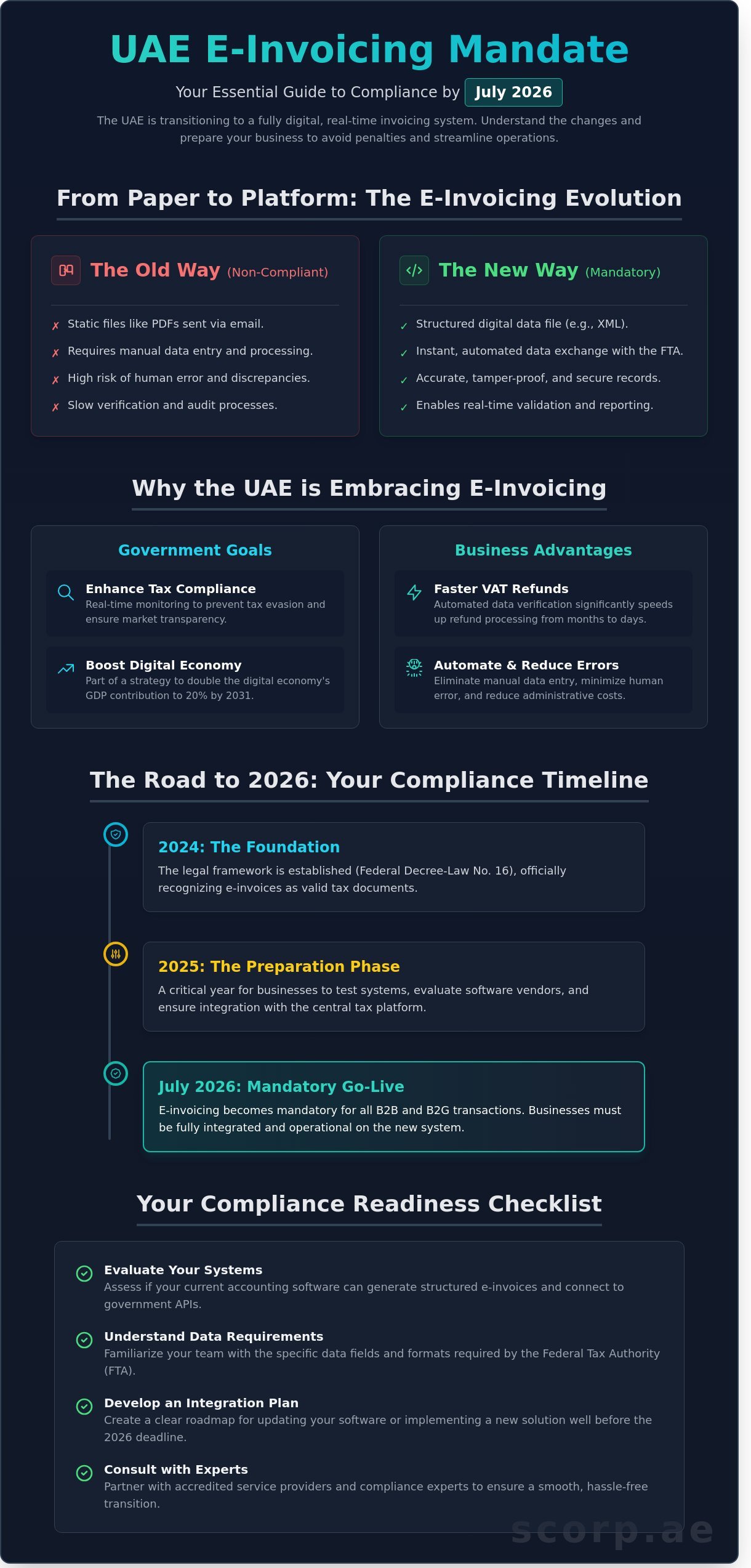
The UAE is transforming its business environment through the UAE Digital Economy Strategy. This strategy aims to double the digital economy’s contribution to the nation’s GDP to 20% by 2031. A central part of this evolution is the transition to electronic billing. You might ask, What is e-invoicing and how does it change your daily operations? Unlike a simple PDF sent via email, an e-invoice is a structured digital file. This file allows for the instant exchange of billing data between your business and the Federal Tax Authority (FTA). It’s a sophisticated way to ensure that tax data is accurate and tamper-proof from the moment it’s created.
Structured data is now the standard the FTA requires to replace traditional paper records. This shift ensures that every transaction is recorded accurately and instantly within the tax system. It’s a move that simplifies long-term VAT reporting for all registered businesses in the Emirates. By 2026, this system will become the standard for the entire country. Understanding what is e-invoicing and when it will required in UAE is essential for staying compliant and avoiding penalties. Our team at Sarsan Corporate Services provides end-to-end solutions to help you navigate these changes with total confidence.
The Legal Foundation of Digital Billing
Federal Decree-Law No. 16 of 2024 provides the legal basis for this digital change. This law officially recognizes electronic invoices as valid tax documents in the UAE. It places the Ministry of Finance in charge of the new regulatory framework for all businesses. They ensure that every company follows specific digital rules when issuing tax documents to clients. Valid tax records must now meet these technical standards to be accepted by the authorities. We help you implement these standards to ensure your business stays on the right side of the law. This legal framework creates a more transparent and secure environment for every entrepreneur in the region.
Why the UAE Is Moving to E-Invoicing
Real-time monitoring is the primary goal of this new mandate. The government wants to prevent tax evasion and fraud before they happen. By seeing transactions as they occur, the FTA can ensure total transparency across the market. This system also benefits compliant UAE companies by speeding up VAT refund processes significantly. In the past, manual audits could take months to complete. Now, automated systems verify data instantly, which means you get your money back faster. It’s a more efficient way to manage your company’s cash flow while staying compliant.
Automating your billing also helps you move away from manual data entry. Manual accounting often leads to human errors that cause tax discrepancies and potential fines. Switching to an automated, error-free system protects your business from these risks. It also allows your staff to focus on growth and strategy rather than tedious paperwork. We see this as a way to streamline your operations and foster a more efficient business culture. As you consider what is e-invoicing and the requirements needed to comply to this, remember that early adoption leads to a more seamless transition.
Planning for the 2026 mandate is not just a regulatory hurdle for your team. It’s a chance to modernize your financial infrastructure and improve your business’s reputation. Preparing early ensures that your company remains a trusted partner in the UAE market. You can expect a more predictable and transparent relationship with tax authorities as these digital tools become the standard for everyone.
The Official Timeline: When Your Business Must Comply
The UAE Ministry of Finance (MoF) has established a clear roadmap for the digital transformation of tax reporting. July 2026 stands as the primary milestone for mandatory compliance across the country. Many business owners currently ask what is e-invoicing and when it will required in UAE to avoid potential penalties or operational disruptions. This transition isn’t just a technical change; it’s a fundamental shift in how you document every transaction.
You must understand that the government is following a phased rollout strategy. This approach allows the authorities to manage the high volume of data while giving businesses time to adapt. Larger corporations and government entities usually lead these transitions because they have the infrastructure to test new systems early. By the time the July 2026 deadline arrives, the framework will be fully stable for all participants.
Key Deadlines for UAE Taxpayers
The journey toward a paperless tax system began well before the final go-live date. 2024 established the legal recognition of e-invoices as official tax documents through Cabinet Decision No. 91 of 2023. This legal foundation ensures that digital records carry the same weight as traditional paper invoices in a court of law or during a tax audit. It’s the first step in creating a trusted digital economy.
2025 served as the critical year for system preparation and infrastructure development. During this period, the MoF focused on the accreditation of software service providers. Last year, business owners took the time to evaluate their current accounting software and ensure it can connect to the central tax platform. Now, the MoF continues to refine the UAE Electronic Invoicing Guidelines to help businesses prepare their data mapping and API integrations.
July 2026 marks the official go-live date for mandatory electronic invoice transmission. From this point forward, the decentralized model will require businesses to report transaction data in real-time or near real-time. This means your system must generate an invoice in the specific XML format required by the Federal Tax Authority (FTA) before you send it to your client.
Who Is in Scope for the 2026 Mandate?
The mandate primarily targets all VAT-registered businesses operating within the UAE. There are currently over 300,000 entities registered for VAT that must prepare for this change. If your business has a TRN (Tax Registration Number), you’re likely in the first wave of required users. The regulation covers both Mainland and Free Zone companies, ensuring a standardized reporting method across all jurisdictions.
- B2B Transactions: All invoices issued to other businesses must be electronic.
- B2G Transactions: Supplies to government departments will require strict adherence to e-invoicing standards.
- B2C Transactions: While Business-to-Consumer requirements might follow in a later phase, some retailers may choose to adopt the technology early for better inventory tracking.
Delaying your preparation until the last minute creates significant risks. You might face integration bottlenecks or find that your preferred service provider is fully booked. Our team offers end-to-end solutions to help you audit your current processes and implement a compliant system well before the 2026 deadline. Taking action now transforms a regulatory hurdle into a competitive advantage for your business growth.
Structured Data vs. PDFs: How E-Invoicing Changes Your Billing
Many business owners believe a PDF invoice sent via email counts as e-invoicing. This is a common misconception. Under the new mandate, a PDF is simply a digital picture of a paper document. It lacks the machine-readable data the Federal Tax Authority (FTA) requires. To understand this new system, you must look at the file format. True e-invoices use structured data like XML or JSON. These formats allow government systems to read your billing information instantly without human help. This shift marks the end of the manual “print and scan” era for 100% of registered taxpayers.
The UAE is moving toward a decentralized model of tax reporting. Your billing software must send data directly to the central platform. This ensures every transaction is recorded as it happens. You can find the specific technical standards in the UAE Ministry of Finance e-invoicing guidelines to ensure your business stays compliant. This “Smile and Pay” system means your software talks to the government’s server in the background. It removes the need for manual tax filings at the end of the quarter. Your data moves from your screen to the FTA platform in seconds.
This transition streamlines your entire financial workflow. It reduces errors that often happen during manual data entry. In the past, 25% of tax disputes arose from simple typing mistakes on paper invoices. Structured data eliminates these risks. It provides a transparent, end-to-end solution for both the buyer and the seller. Your business gains efficiency while the government gains better visibility into the economy. It is a win-win for the UAE’s digital future.
The Technical Requirements of a Valid E-Invoice
A valid e-invoice must contain specific data points to be legal. You must include your Tax Registration Number (TRN) and the buyer’s full legal details. Every invoice also needs specific tax codes for each line item sold. A unique digital signature is the most critical part of this file. This signature acts as a digital seal. It proves the invoice is authentic and hasn’t been changed since it was issued. Your system must report these details in real-time. This allows the FTA to track B2B transactions as they occur across the country. Failure to meet these technical standards can result in fines starting from 5,000 AED.
Why Your Current Accounting Software Might Need an Upgrade
Your current accounting software might not be ready for this change. Older “on-premise” systems often cannot generate the required XML or JSON files. They lack the API connections needed to talk to the FTA’s platform. You will likely need to integrate your billing tools with accredited service providers. Modern cloud-based tools offer seamless solutions for this transition. These tools automate the entire process for you. They turn a complex legal requirement into a simple part of your daily workflow. Upgrading now ensures your business remains a trusted partner in the UAE market. It also prepares you for the full rollout in July 2026. Transitioning to a compliant system is a hassle-free way to protect your company’s future success.
Understanding what is e-invoicing and when it will be required in the UAE is the first step toward digital maturity. By moving away from PDFs and toward structured data, you protect your business from penalties. You also gain a faster, more reliable way to manage your cash flow. This technology is not just a hurdle; it is a gateway to a more efficient business model.
A Step-by-Step Readiness Checklist for UAE Businesses
Preparing for the new digital tax regime requires a proactive strategy. You don’t want to wait until the final months to understand this system. The Ministry of Finance follows a phased approach to ensure a smooth transition. Your first step involves calculating your annual taxable turnover for the last fiscal year. If your revenue exceeds AED 100 million, you will likely fall into the first wave of the July 2026 rollout. Smaller businesses will follow in subsequent phases through 2027. This tiered system gives every entrepreneur time to adapt without disrupting daily operations.
Next, you must audit your current billing workflow. Statistics show that many local companies still rely on manual data entry for 40% of their invoicing tasks. This manual process creates significant risk for errors. You should consult with professionals to ensure your Dubai business setup services include comprehensive tax compliance from the start. A trusted partner helps you avoid the steep penalties associated with non-compliance. Once you understand your specific needs, select an Accredited Service Provider (ASP). The Ministry of Finance approves these specific vendors to ensure secure data transmission to the central tax platform.
Finally, focus on your people. Train your finance team on the new digital workflow and reporting requirements immediately. They need to understand how to handle real-time validations and what to do if an invoice is rejected by the tax portal. Providing this training early builds confidence and ensures your business remains efficient when the mandate begins.
Evaluating Your ERP and Accounting Systems
Your accounting software is the heart of this transition. Contact your software vendor today to see if they are building a UAE-specific compliance update. You must also clean your master data. Many databases lack valid Tax Registration Numbers (TRN) for every client. Without a TRN, the new system will reject your invoice instantly. Aim to test your system with a small batch of 50 invoices by late 2025. This identifies technical bugs well before the 2026 deadline.
Managing the Transition and Change
Change management involves your entire supply chain. Inform your suppliers that you will only accept electronic formats starting in 2026. This prevents bottlenecks in your accounts payable department. You must also secure your digital archive. The Federal Tax Authority (FTA) requires you to keep records for ten years. Use encrypted cloud storage with restricted access. This protects your data and meets internal control standards. It also prevents unauthorized staff from altering sensitive financial records. Clear communication ensures that everyone knows what e-invoicing is.
Ready to secure your business future and ensure total compliance? Partner with Sarsan Corporate Services to streamline your transition today.
How Sarsan Corporate Services Simplifies Your Compliance Journey
Sarsan Corporate Services acts as your expert guide for end-to-end business solutions in the UAE. We understand that the local regulatory environment moves quickly. Our team simplifies every step of your journey from initial licensing to complex tax filings. We handle the heavy lifting of VAT registration and ongoing compliance so you can focus on scaling your operations. Our legacy is built on transparency and hassle-free service delivery for every client we represent.
Business owners often ask our experts, “What is e-invoicing? When it will be required in UAE?” during their initial setup phase. We provide clear answers and actionable strategies to ensure your firm meets all legal standards. You won’t find hidden costs or surprise fees in our service agreements. We believe in building long-term trust through reliable and honest communication. Our professionals manage the evolving regulatory landscape while you dedicate your energy to business growth and innovation.
Seamless Business Setup and Regulatory Support
We integrate tax readiness directly into your initial company formation process from the very first day. This proactive approach ensures your business is compliant before you even issue your first invoice. Our consultants monitor every Ministry of Finance update to keep you informed about changing laws and deadlines. We don’t just register companies; we find the right corporate structure for your specific professional goals. Whether you need a Mainland setup or a Free Zone license, we tailor our advice to your needs.
Our team uses a personalized approach to help you choose between different legal forms and jurisdictions. This precision helps you avoid costly penalties that often arise from incorrect tax registrations or licensing errors. We provide a clear roadmap to prevent any operational delays.
- Expert Guidance: We provide step-by-step assistance for VAT and corporate tax registration.
- Document Management: Our team handles all filings with the Ministry of Finance and other authorities.
- Regulatory Alerts: You receive timely updates on new compliance requirements as they are announced.
- Structural Optimization: We ensure your business setup allows for maximum tax efficiency and growth.
Your Trusted Partner for Long-Term Success
Our relationship continues long after the authorities issue your trade license and residency visas. We provide ongoing support to ensure your business thrives in the competitive UAE market. Managing VAT returns and e-invoice submissions requires constant attention to detail and technical expertise. Our experts take over these administrative tasks to give you total peace of mind every month. We act as an extension of your team to ensure your financial records remain audit-ready at all times.
The UAE business landscape offers incredible opportunities for those who maintain high compliance standards. We help you protect your reputation by ensuring you never miss a filing deadline or a regulatory change. You can contact us today for a free consultation on e-invoicing and tax readiness. We simplify the complexities of the UAE business journey to make it truly effortless for you. Let us manage the technicalities of the law while you build your empire in the heart of the Middle East.
Secure Your Future in the UAE Digital Economy
The transition to a digital billing system marks a significant milestone for the Emirates’ business environment. By July 2026, companies must shift from traditional PDFs to structured XML data to remain compliant with federal regulations. Understanding the e-invoicing system ensures your operations continue without any legal interruptions or unexpected fines. This change helps streamline tax reporting and improves transparency across all commercial sectors. You’ll find that early preparation protects your cash flow and builds stronger trust with your corporate partners.
Frequently Asked Questions
Is e-invoicing mandatory for all businesses in the UAE?
Yes, e-invoicing is mandatory for all VAT-registered businesses across the UAE. The Ministry of Finance requires every taxable person to transition to the new digital system in phases. This mandate covers both Mainland and Free Zone companies to ensure a transparent tax environment. It’s a vital step to streamline business operations and improve national tax compliance.
What is the deadline for e-invoicing compliance in the UAE?
The final deadline for full e-invoicing compliance in the UAE is July 2026. The government will begin the development and testing phase in July 2025 for selected taxpayers. You should start reviewing your current accounting systems now to ensure a seamless transition. Early adoption helps you avoid last-minute technical hurdles and ensures your business remains fully compliant.
Can I still use paper invoices after July 2026?
No, you cannot use traditional paper invoices for B2B or B2G transactions after July 2026. The law requires all invoices to be issued, sent, and received in a structured electronic format. These digital files must meet specific Federal Tax Authority standards for validation. Switching to electronic records makes your bookkeeping more efficient and removes the need for physical storage space.
Do I need special software to issue an electronic invoice?
Yes, you need accounting software that integrates with the UAE’s central e-invoicing platform. Your system must be able to generate XML or PDF/A-3 files that include mandatory cryptographic signatures. Many entrepreneurs choose end-to-end solutions to automate this complex process. This technology ensures your invoices are sent instantly and meet all legal requirements without manual effort.
What are the penalties for not using the e-invoicing system?
Penalties for failing to comply with e-invoicing rules can start at AED 10,000 for initial violations. Repeated non-compliance or failure to maintain digital records can lead to fines of AED 50,000. These strict measures ensure every business follows the same digital standards. Our team helps you implement a hassle-free system to protect your company from these heavy financial burdens.
How does e-invoicing affect my VAT returns?
E-invoicing simplifies your VAT returns by automatically reporting transaction data to the Federal Tax Authority. This digital link reduces manual data entry errors and makes tax filing much faster. It’s essential to understand what is e-invoicing and when it will required in UAE to maximize your tax efficiency. You’ll enjoy more accurate input tax claims and a clearer view of your financial health.
Does e-invoicing apply to free zone companies?
Yes, e-invoicing applies to all Free Zone companies that are registered for VAT in the UAE. Whether you operate in a specialized hub or on the Mainland, the digital requirements remain the same. The system creates a uniform standard for all business setup types across the seven Emirates. We provide tailored guidance to help Free Zone entrepreneurs transition to this digital model with ease.
What is an Accredited Service Provider (ASP) in the UAE?
An Accredited Service Provider is a certified vendor authorized to facilitate electronic invoice exchanges. These providers offer the secure infrastructure needed to transmit your data directly to the government’s tax portal. Using an ASP ensures your business follows the correct technical protocols and encryption standards. It’s the most reliable way to maintain a seamless and compliant billing process.