























Is your international wealth truly protected if your corporate structure still relies on outdated, high-tax models? You likely feel that it’s difficult to distinguish between Free Zones and offshore entities during your research. This confusion often leads to unnecessary delays or compliance risks that threaten your long-term financial security. Our definitive guide helps you master the complexities of an offshore company setup in the UAE. We provide the end-to-end solutions you need to transform these entrepreneurial aspirations and to secure your global assets efficiently.
You deserve a seamless process that guarantees 100% foreign ownership and zero corporate tax on all international profits. We promise to show you exactly how to maintain high financial privacy while meeting the 2026 global transparency standards. This article outlines the specific banking protocols and legal frameworks required for a successful, hassle-free offshore formation. You’ll discover how to streamline your international operations and protect your wealth with absolute confidence.
Key Takeaways
Understand how an offshore entity functions as an International Business Company to optimize your international tax strategy effectively.
Discover the most suitable jurisdiction for your offshore company by comparing JAFZA and RAKICC frameworks today.
Master the use of offshore structures to safeguard your global asset portfolios and streamline international estate planning processes seamlessly.
Navigate the registration process with ease by following our professional guide to appointing registered agents and securing name approvals.
Stay ahead of regulatory changes by understanding Economic Substance Regulations and the 2026 corporate tax landscape for non-resident entities.
What is an Offshore Company Setup in the UAE?
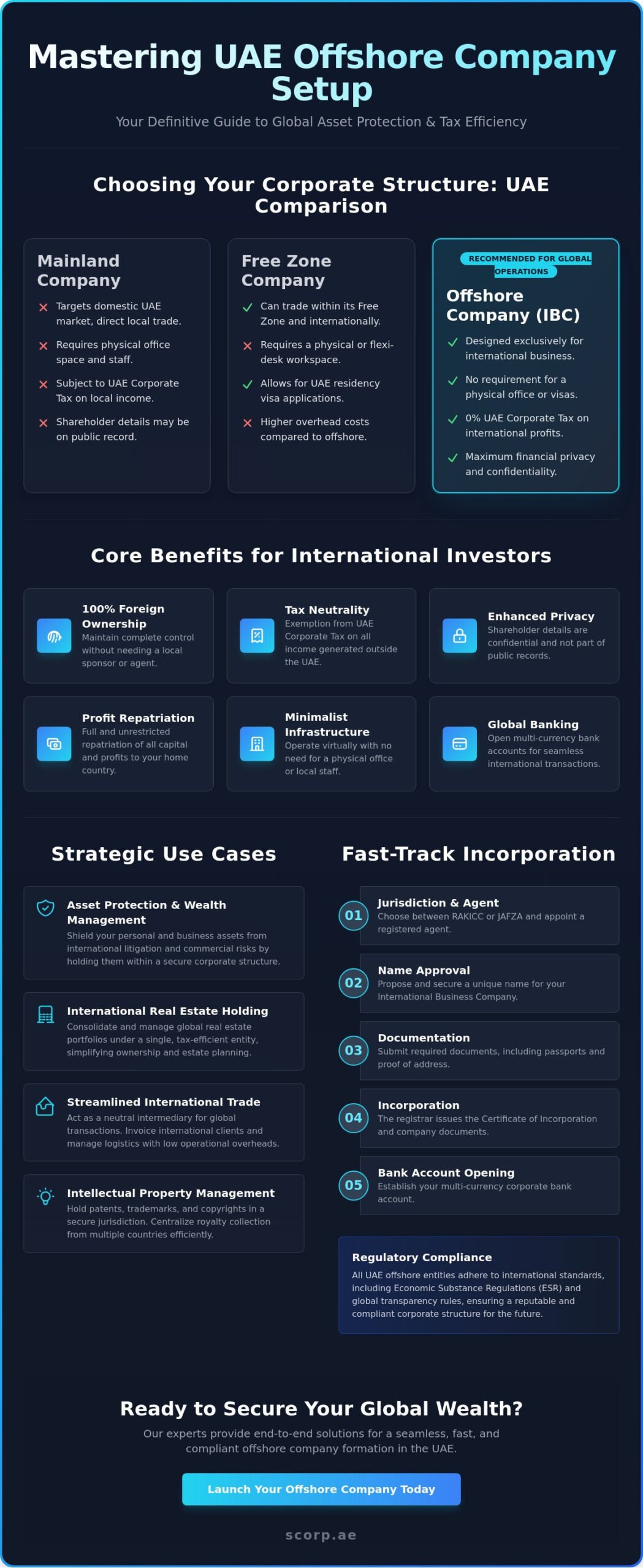
An offshore company in the UAE functions as an International Business Company (IBC) designed for global operations. Unlike mainland or free zone entities, these companies don’t conduct business within the local UAE market. This structure allows investors to manage international trade and hold global assets through a secure, tax-efficient vehicle. Sarsan Corporate Services provides end-to-end solutions to help you establish these entities with speed and precision.
As a leading Offshore Financial Centre, the UAE provides a stable environment for entrepreneurs who need robust legal protection. Local mainland companies require physical offices and often target the domestic market. Free zone companies allow local trade with specific permits but require physical workspace. In contrast, an offshore company setup in UAE offers a virtual presence without the overhead costs of office space or employee visas.
The UAE remains a premier global hub because it combines modern infrastructure with a business-friendly regulatory environment. Investors typically choose this path for three primary reasons. First, it streamlines international trade by providing a neutral base for global transactions. Second, it serves as an excellent vehicle for asset holding, such as real estate or shares in other companies. Finally, it offers a secure framework for intellectual property management and royalty collection.
The Legal Framework of UAE Offshore Entities
The legal structure of these entities relies on specific jurisdictions like RAKICC or JAFZA. These authorities act as the Registrar, ensuring every company follows strict international compliance standards. While the UAE maintains high levels of investor privacy, it also adheres to global transparency rules to prevent financial crimes. These companies maintain a non-resident status for tax purposes; therefore, they cannot apply for UAE residency visas or rent physical office space.
Core Benefits for International Investors in 2026
Investors choose this path because it offers 100% foreign ownership and complete control over corporate assets. You don’t need a local sponsor or service agent to manage your business operations. Additionally, companies enjoy exemption from UAE Corporate Tax on income generated outside the country as of 2026. Shareholder details remain confidential and aren’t part of public records, providing an extra layer of security for high-net-worth individuals. This offshore company setup ensures your global wealth remains protected within a reputable jurisdiction.
Full repatriation of profits and capital to your home country.
No requirement for a physical office or local staff.
Multi-currency bank accounts to facilitate seamless global payments.
Fast incorporation process through experienced corporate service providers.
Strategic Advantages of UAE Offshore Company Formation
Setting up an offshore entity provides a secure gateway for managing diverse international portfolios and high-value physical assets. Investors, eyeing to expand their business in UAE, often choose an offshore company setup to safeguard their global wealth within a stable legal environment. This corporate structure acts as a robust shield, separating personal wealth from potential international litigation and commercial risks. It’s an ideal vehicle for holding international real estate portfolios, allowing owners to consolidate property holdings under one entity. Additionally, these companies simplify royalty and patent management by providing a centralized hub for intellectual property rights.
Offshore entities excel at facilitating international trade by acting as an intermediary for goods and services sold globally. This setup allows businesses to invoice international clients while keeping their operational costs low and their logistics streamlined. Managing intellectual property through a UAE offshore company ensures that your patents and trademarks are held in a secure jurisdiction. This strategy allows you to collect royalty payments from various countries while benefiting from a centralized and efficient administrative structure. By using a multi-currency account, you can avoid unnecessary exchange rate fluctuations and keep your capital liquid for new opportunities. This approach provides the flexibility needed to respond quickly to market changes and scale your business across different continents. Our team delivers end-to-end solutions to help you navigate these legal requirements with complete confidence.
Asset Protection and Wealth Management
Asset protection remains a primary driver for entrepreneurs seeking long-term security for their families and business interests. By integrating offshore companies into complex trust or foundation structures, you create a multi-layered defense for your capital. The legal framework, particularly the JAFZA Regulations, provides clear guidelines for corporate governance and shareholder protection. This stability ensures that your wealth preservation strategy remains intact despite shifts in the global economic climate.
Tax Neutrality and Financial Efficiency
The UAE maintains a tax-neutral status while adhering to international transparency standards set by the OECD. Operating within this white-listed framework allows your business to avoid the negative stigma of traditional tax havens. You can streamline global dividend distributions through a central holding company, ensuring that your financial operations remain efficient. Most offshore entities benefit from 0% corporate tax on foreign-sourced income, which maximizes your total return on investment. If you’re ready to optimize your corporate structure, you can reach out to our consultants for a personalized assessment.
Choosing Your Jurisdiction: JAFZA vs. RAKICC
Selecting the right jurisdiction is a critical step for your offshore company setup in UAE. You must align your corporate choice with your specific business goals and banking requirements. JAFZA offers high prestige in Dubai, while RAKICC provides a flexible and cost-effective environment. Both options provide unique benefits that cater to different types of international business activities and investment strategies. Choosing the wrong registry can lead to operational delays or difficulties in accessing financial services.
Choosing a jurisdiction recognized by international banks is vital for your long-term operational success. Financial institutions prefer registries that maintain strict compliance standards and transparent legal frameworks. Consequently, your choice between JAFZA and RAKICC will impact your ability to open and maintain corporate accounts. You should consult with experts to ensure your business structure meets these global banking expectations. Reliable jurisdictions reduce the risk of account closures and facilitate smoother international transactions for your firm. Many banks maintain specific lists of approved offshore registries they accept for new account openings.
JAFZA Offshore: The Dubai Connection
JAFZA remains the only jurisdiction allowing offshore companies to own freehold property in Dubai directly. This unique feature makes it the preferred choice for real estate investors seeking asset protection. While the setup costs are higher, the global recognition of Jebel Ali provides advantages for banking. The registration timeline typically spans 10 to 15 working days for most new applications. Investors often choose this route to leverage the premium reputation associated with a Dubai-based registration.
RAKICC: Flexibility and Speed
The RAK International Corporate Centre serves as the most popular registry for general holding companies. It offers a streamlined process that allows for rapid incorporation within 48 to 72 hours. Many international firms choose RAKICC because it permits the easy migration of existing offshore companies. Annual renewal fees remain significantly lower here, making it a sustainable option for business. This flexibility allows entrepreneurs to manage their global assets without the premium costs of other regions.
Selecting the ideal registry requires a deep understanding of your intended business activities and future growth. Our team provides Dubai business setup services to help you navigate these complex decisions. We ensure that your offshore company setup in UAE complies with all local and international regulations. Our consultants offer end-to-end solutions that simplify the entire registration process for our clients. Contact us today to start your journey with a trusted partner in the UAE.
Step-by-Step Guide to Offshore Company Registration
You can achieve a seamless offshore company setup in UAE by following a clearly defined and structured regulatory path. The process begins when you appoint a licensed registered agent to manage all communications with the local authorities. You must choose a unique company name that does not conflict with any existing registered entities in the UAE. The registrar typically requires three distinct name options to ensure your chosen entity name complies with legal standards. Once the name is approved, your agent prepares the necessary constitutional documents for your final review and signature.
Your agent drafts the Memorandum and Articles of Association to define the company’s internal structure and operational rules. This legal document outlines the share capital and the specific powers granted to the directors of the entity. After you sign these documents, the agent submits the complete application package to the relevant offshore registrar. You will receive a Certificate of Incorporation once the authorities verify all your details and approve the final application. This certificate serves as the official birth certificate of your entity, allowing you to open international bank accounts.
Appoint a licensed agent to act as your official liaison with the UAE registration authorities.
Submit three unique name choices for approval to ensure compliance with local naming conventions and regulations.
Sign the Memorandum and Articles of Association to establish the legal framework for your new offshore entity.
Receive your Certificate of Incorporation to finalize the registration and begin your global business operations immediately.
Required Documentation for Shareholders
The registration process requires specific documents to verify the identity and professional background of all company shareholders and directors. You need to provide high-quality, certified copies of your passport along with recent proof of your residential address. Banks or legal firms must issue professional reference letters to confirm your financial standing and your business reputation. A detailed CV helps the registrar understand your professional experience and the nature of your planned international activities. These documents ensure your offshore company setup meets all modern transparency and compliance requirements.
The Role of the Registered Agent
UAE law mandates that you use a licensed agent to facilitate your offshore registration and maintain legal compliance. Sarsan Corporate Services acts as your expert liaison, ensuring every document meets the strict standards of the registrar. We handle the initial application and provide essential support for your annual filings and license renewals every year. Our team simplifies the complex administrative tasks so you can focus on growing your global business ventures successfully. We provide end-to-end solutions that protect your interests and keep your company in good standing with the authorities.
Ready to expand your global reach? Contact our expert team today to begin your professional offshore registration process.
Compliance and Post-Incorporation Maintenance in 2026
Successful offshore company setup in UAE requires a deep commitment to local compliance standards and regulatory frameworks. It’s vital to stay ahead of these requirements to protect your investment and maintain a seamless corporate presence. You must understand the Economic Substance Regulations to ensure your entity remains in good standing with the authorities. Entities performing relevant activities must submit an annual ESR notification to avoid administrative penalties exceeding AED 20,000. For the 2026 tax year, non-resident companies must evaluate their tax residency status under the current corporate tax laws. Non-resident companies must register for corporate tax if they earn income from real estate located within the UAE territory. You should maintain accurate financial records for five years to meet the strict requirements of UAE regulatory authorities. While annual audits are not always mandatory for every offshore jurisdiction, they provide essential transparency for your banking partners.
Regulatory Reporting Obligations
Filing annual returns is a mandatory step to prove your company is still active and operating within the law. You should also prepare for frequent Anti-Money Laundering checks by keeping your KYC documents updated and ready for review. The Ultimate Beneficial Owner declaration requires you to identify all individuals who hold significant control over your offshore entity. You must update the UBO registry within fifteen days if any changes occur in your company ownership structure. It’s important to remember that the UAE Ministry of Finance continues to update reporting portals for better efficiency.
Submit annual returns to the relevant registrar to keep the company in good legal standing.
Comply with all Anti-Money Laundering and KYC update requests from your registered agent or local banks.
Provide accurate Ultimate Beneficial Owner declarations to ensure full transparency with the UAE corporate registries.
Corporate Banking for Offshore Entities
Opening a corporate bank account for an offshore entity is often the most challenging part of the setup process. Banks require a comprehensive set of documents including proof of address, source of wealth, and detailed business plans. Don’t underestimate the complexity of these applications as the regulatory environment in the UAE continues to mature rapidly. Most banks now prioritize companies that demonstrate clear economic substance and very transparent management structures. You can explore our Dubai business setup services to receive professional guidance through the complex banking application stages.
Specialized consultancy support helps you identify the banks that best match your specific business activities and risk profile.
Essential documents usually include six months of personal bank statements and verified proof of your professional background.
Our team provides end-to-end solutions that streamline the onboarding process and increase your chances of a successful opening.
Maintaining a healthy relationship with your bank involves providing timely updates on your business activities and financial transactions. Trusting an experienced partner ensures that your offshore company setup in UAE remains compliant and fully operational for years. We stay by your side to handle every administrative detail so you can focus on growing your business. Our relationship doesn’t end after the initial setup because we are committed to your long-term success in the region.
Secure Your Global Future with Strategic UAE Formation
Establishing an offshore entity provides critical tax optimization and asset protection for global entrepreneurs entering the 2026 market. You must choose between RAKICC or JAFZA jurisdictions to align with your specific international business goals. Our team at Sarsan Corporate Services streamlines the entire offshore company setup in UAE, so you can focus on driving global growth. You’ll benefit from our deep local expertise and a seamless process that transforms your vision into a reality. We’re committed to your long-term success and offer ongoing support well after your initial incorporation is complete. Take the first step today to secure your corporate future within one of the world’s most stable economies. Our specialists are ready to help you navigate the latest 2026 regulations with confidence and total peace of mind.