





























UAE e-invoicing will be introduced this year to entrepreneurs and companies. For any new business, navigating the UAE Value Added Tax (VAT) system is a critical step. Successfully registering for VAT is more than a legal requirement; it is a strategic milestone. This process fully integrates your company into the UAE’s advanced digital economy. It also ensures your new venture remains compliant with the evolving 2026 tax regulations. This guide simplifies the government’s requirements into a clear and manageable business workflow.
Understanding UAE VAT for New Business Owners in 2026
Value Added Tax, or VAT, is a 5% indirect tax applied to most goods and services in the UAE. The Federal Tax Authority (FTA) manages this legal requirement for all businesses. A key part of this process involves obtaining a Tax Registration Number (TRN). This number is essential for your daily business operations and legal compliance. Properly planning for tax obligations from the beginning is crucial. At Sarsan Corporate Services, we integrate tax planning directly into the initial company setup process for a seamless start.
The Role of the Federal Tax Authority (FTA)
The FTA is the primary government body responsible for tax administration and collection across the UAE. It has transitioned all tax services to its modern digital platform, Emaratax. For 2026, the FTA is heavily focused on increasing transparency through digital compliance. Therefore, understanding how to interact with this platform is vital for every new business owner. The authority sets the rules and ensures all companies adhere to them. (Overview of UAE Taxation)
Why Your New Company Needs a TRN
A Tax Registration Number is fundamental to your business’s financial health and credibility. Your TRN allows you to legally charge VAT on your sales and reclaim the VAT you pay on business expenses. This process helps you manage cash flow effectively. Furthermore, possessing a TRN establishes trust with corporate clients and government entities. It also becomes mandatory if you plan to import any goods into the UAE for your business activities.
Mandatory vs. Voluntary VAT Registration Thresholds
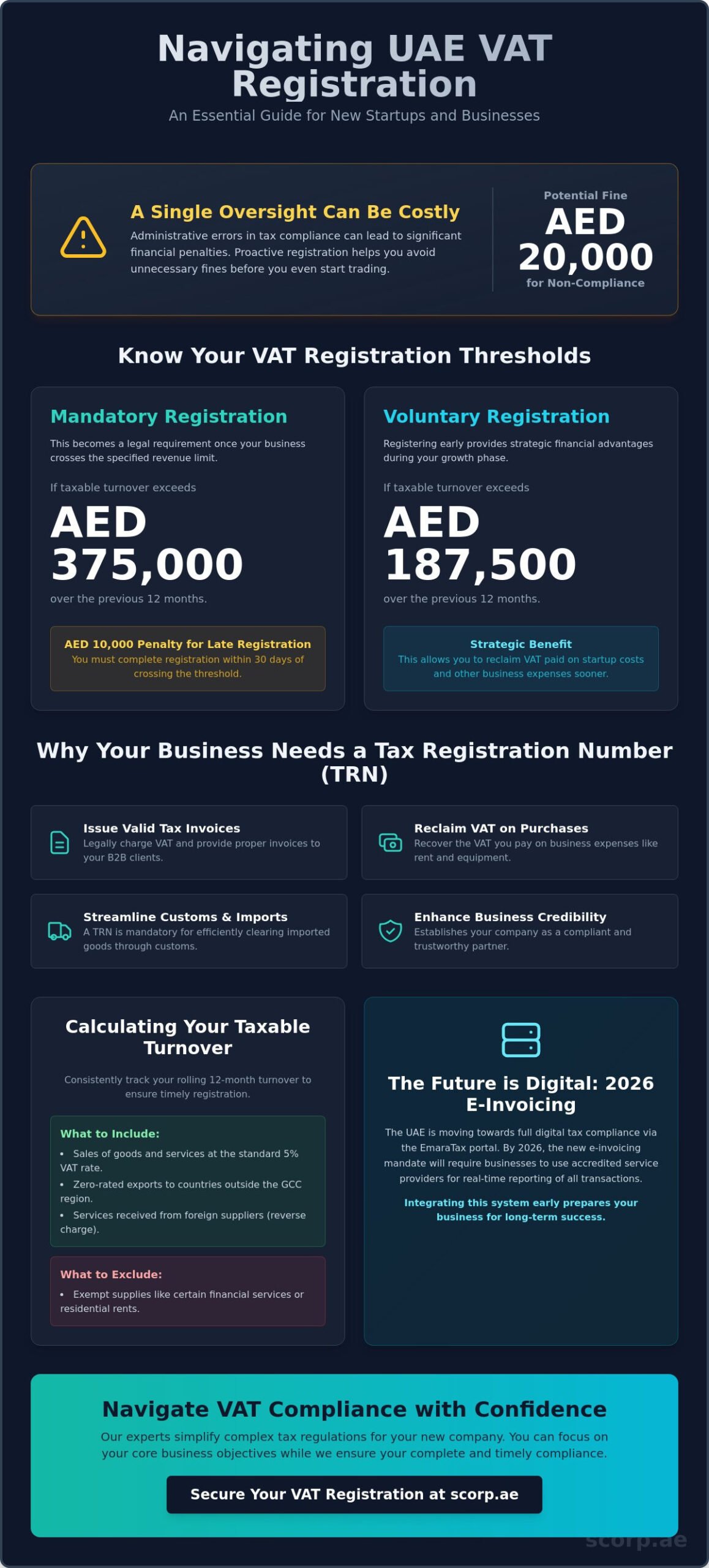
The UAE has established clear financial thresholds to determine when a business must register for VAT. You must register if your taxable supplies and imports exceeded AED 375,000 over the past 12 months. This is the mandatory registration threshold. Once you cross this limit, you have a 30-day grace period to submit your application to the FTA.
Alternatively, you can choose to register voluntarily. This option is available if your taxable supplies and imports exceeded AED 187,500 in the last 12 months. To calculate your taxable supplies, you should include all standard-rated and zero-rated items you sell. (Official VAT Registration Thresholds)
Calculating Your Taxable Turnover Accurately
To determine if you meet the threshold, you must track your turnover on a rolling 12-month basis. Your turnover includes domestic sales and any services you import. It is important to distinguish between exempt supplies and zero-rated supplies. While both have a 0% VAT rate for the consumer, only zero-rated supplies count toward your registration threshold. A simple formula is to sum your total revenue from non-exempt goods and services over the last year.
Strategic Benefits of Voluntary Registration
Registering for VAT voluntarily offers significant advantages for a new company. It allows you to recover the VAT you paid on startup costs, such as office equipment and professional fees. This can provide a valuable cash injection during your early stages. Moreover, voluntary registration prepares your business for larger B2B contracts, as many corporations require their suppliers to be VAT-registered. Finally, it helps you avoid the risk of accidental late registration and the associated penalties.
Essential Checklist: Documents Required for Registration
The Federal Tax Authority requires a specific set of documents for VAT registration. Gathering these items in advance will ensure your application process is smooth and efficient. All documents must be clear, currently valid, and uploaded in the required digital formats. The primary corporate documents include your company’s trade license and its Memorandum of Association.
You will also need to provide identification for the business owners and managers. This typically includes passport copies and Emirates IDs. Additionally, you must have a corporate bank account and proof of a physical office space. (UAE VAT Registration Thresholds)
Corporate and Legal Documentation
A valid UAE trade license from your specific jurisdiction is the most important document. You will also need to submit the company’s Articles of Association. If someone is applying on behalf of the company, a formal power of attorney document is required. Understanding the costs associated with licensing is a key part of this stage. For more context, you can review a comprehensive breakdown of company formation costs in the UAE.
Financial and Activity Records
The FTA needs to understand your business operations and financial projections. You must provide a detailed description of your business activities. You should also include your expected turnover figures for the upcoming year. If your company plans to import goods, you must provide details regarding your customs registration. For voluntary applications, a statement of projected sales helps justify your request for early registration.
The 2026 VAT Registration Process and E-Invoicing
The VAT registration process is now fully digital and integrated with other government systems. A major change is the link between your TRN and the upcoming e-invoicing mandate. Following the correct steps ensures your business is prepared for the future of tax reporting in the UAE.
- Set up your UAE Pass: First, you must create a UAE Pass account for secure authentication on the Emaratax portal.
- Create your tax account: Next, create your taxable person account and fill out the online registration form completely.
- Upload required documents: Then, upload all the necessary documents in the specified digital formats and submit the application.
- Respond to clarifications: The FTA may request more information. You must respond promptly to avoid application rejection.
- Receive your TRN: Finally, upon approval, you will receive your TRN and can prepare for the 2026 e-invoicing transition.
Navigating the Emaratax Portal and UAE Pass
UAE Pass has become the mandatory gateway for accessing all UAE government digital services, including Emaratax. To ensure a smooth application, double-check all data entries for accuracy before submission. Common errors, such as incorrect dates or names, are the primary cause of application delays. A clean, error-free application minimizes the need for manual intervention from the FTA.
Linking VAT to the 2026 E-Invoicing Mandate
The upcoming e-invoicing system is a significant step in the UAE’s digital transformation. Your TRN will serve as your unique identifier on the Peppol network, which facilitates this system. By 2026, businesses will be required to report tax documents in near real-time. This move toward automated VAT reporting will eventually replace the need for manual tax return filings. You can learn more in this detailed guide to the e-invoicing system in UAE.
Simplifying UAE Compliance with Sarsan Corporate Services
Navigating these regulations can be complex for new entrepreneurs. Sarsan Corporate Services offers professional guidance to ensure your VAT registration is accurate and error-free. We bridge the gap between initial business licensing and your ongoing tax compliance obligations. Our experienced team manages the entire application process and all communication with the FTA on your behalf. We also provide strategic advice on corporate structures to optimize your company’s VAT position from day one.
Expert Support for Dubai Business Setup
Our comprehensive Dubai business setup services include tax readiness checks to prepare you for compliance. We help you understand the specific VAT nuances for companies operating within different jurisdictions. This is especially important when choosing from the best free zones to set up a business in Dubai. You can benefit from our decade of experience navigating the UAE’s dynamic regulatory landscape.
Start Your Tax-Compliant Journey Today
Ensure your new company is fully prepared for the 2026 digital tax requirements. By partnering with a reliable corporate service provider, you can avoid costly errors and penalties. Let our experts handle the complexities of tax registration while you focus on growing your business. Contact us today to schedule a consultation and begin your journey toward full compliance.