























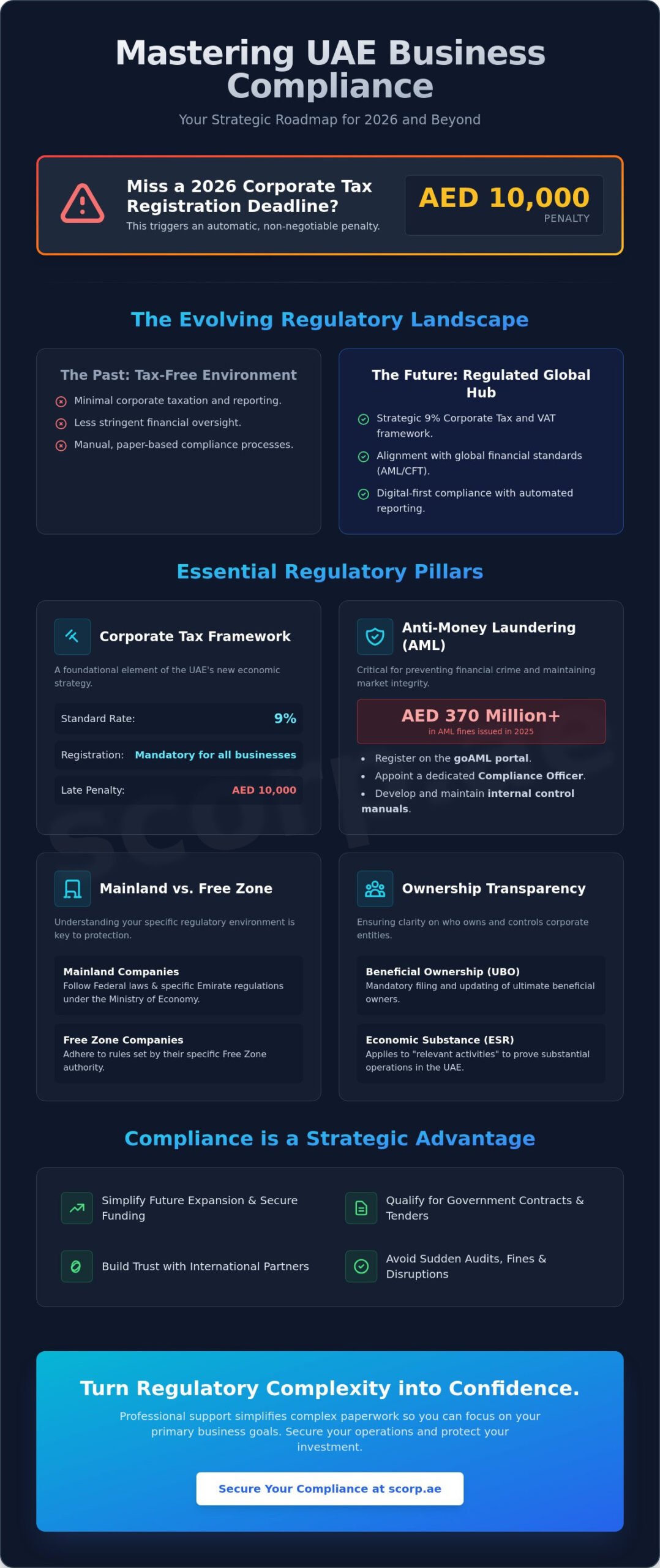
Did you know that missing a single corporate tax registration deadline in 2026 triggers an automatic AED 10,000 penalty? This reality highlights why mastering business compliance in the UAE is no longer just a legal task but a strategic necessity. You’ve likely felt the pressure of shifting 9% corporate tax rates and new Emiratisation targets for your team. It’s natural to feel overwhelmed by the complex differences between Mainland and Free Zone regulatory requirements. We understand that these constant changes can feel like a major hurdle to your company’s growth and stability.
You deserve a clear path that protects your investment and ensures your operations run without any costly disruptions. This guide provides a complete roadmap to help you manage your legal obligations with total confidence and ease. We’ll explore essential tax deadlines, updated VAT laws, and the latest anti-money laundering frameworks for the year ahead. Our goal is to simplify these complex rules so you can focus on growing your core business activities. By following this structured approach, you can turn regulatory requirements into a solid foundation for your long-term success.
Key Takeaways
- Understand how the UAE evolved into a regulated hub and what these changes mean for your business growth.
- Master the core pillars of business compliance in the UAE by learning the latest AML rules and UBO filing steps.
- Differentiate between Mainland and Free Zone regulations to ensure your specific legal structure stays fully protected and compliant.
- Follow mandatory corporate tax registration and VAT thresholds to avoid heavy fines and ensure smooth financial reporting cycles.
- Explore how professional support simplifies complex regulatory paperwork so you can focus on your primary business goals today.
Understanding the Foundations of Business Compliance in the UAE
Business compliance in the UAE involves following federal laws and specific regulations set by each emirate. Local licensing authorities in each region create specific rules that complement federal mandates. This framework ensures that companies operate fairly and transparently within a competitive global market. The Ministry of Economy plays a vital role by supervising both onshore and offshore business activities. They work closely with local departments to maintain high standards of corporate governance across the country. The UAE Corporate Law Framework defines the legal structures and obligations for every registered entity. Understanding these foundations is the first step toward building a sustainable and successful enterprise.
The Emirates recently moved from a tax-free environment to a more regulated global hub. This transition reflects the nation’s commitment to meeting international financial standards and preventing illegal activities. You must realize that compliance is now a mandatory part of your daily operations. Staying current with these rules protects your corporate bank account against sudden freezes or closures. It also ensures that your residency visa status remains valid and secure for the long term. A transparent relationship with the Central Bank is essential for maintaining your financial liquidity. Neglecting these duties can lead to operational disruptions that harm your professional reputation and growth.
The Evolving Regulatory Landscape for 2026
The shift toward digital-first compliance is a major trend for businesses operating in the Emirates. Authorities now require automated reporting and electronic filing for most corporate and tax tasks. This digital approach increases transparency and allows the government to track financial data more efficiently. The UAE aligns its local laws with international standards to attract the best global investors. These investors look for jurisdictions that prioritize clarity, security, and a strong legal foundation. Every corporate structure must now provide more detailed information about its owners and financial health. This alignment with global standards ensures that the UAE remains a credible and transparent marketplace.
Why Compliance is Your Greatest Strategic Advantage
Maintaining a clean compliance record simplifies your future expansions and helps you secure corporate funding. Banks and financial institutions prefer working with companies that demonstrate a strong commitment to governance. Prioritizing compliance in your business ensures that your firm remains eligible for government contracts and tenders. This proactive approach builds trust with international partners and high-tier vendors who value reliability. You can avoid the stress of unexpected audits by keeping your records accurate and up to date. Robust internal controls allow you to spot risks before they turn into expensive legal problems. Compliance is the key to long-term operational stability for any business in Dubai.
Essential Regulatory Pillars for Every UAE Company
Every company in the Emirates must build its operations on several key regulatory pillars to ensure long-term success. These foundational rules create a transparent environment that protects both the business and the wider national economy. Mastering business compliance in the UAE requires a deep understanding of these specific federal mandates and reporting cycles. Central to this framework is the National Economic Register, which acts as a unified platform for tracking business data. By following these standards, you protect your legal standing and maintain a healthy relationship with the UAE Federal Tax Authority. Implementing these pillars correctly allows your business to thrive without the fear of sudden regulatory interruptions or fines.
Authorities use these registers to ensure that every entity operates within the bounds of international financial safety protocols. You should view these requirements as a shield that guards your corporate reputation in the global market. Maintaining accurate data is not just a chore; it’s a vital part of your professional identity. When you keep your records updated, you signal to partners that your firm is a reliable and stable collaborator.
Anti-Money Laundering (AML) and CFT Compliance
The UAE has implemented a rigorous AML and Combatting the Financing of Terrorism (CFT) framework to prevent financial crimes. In 2025 alone, the Central Bank issued over AED 370 million in fines for AML non-compliance across various sectors. Specific designated non-financial businesses must register on the goAML portal to report suspicious transactions effectively. You must also appoint a dedicated Compliance Officer to oversee your internal processes and ensure full regulatory adherence. This officer is responsible for training your staff and maintaining high standards of due diligence across all transactions. Creating detailed internal manuals is another mandatory step for businesses operating in high-risk sectors like real estate or gold trading. Failure to follow these rules can lead to massive financial penalties or the suspension of your commercial license.
Economic Substance and Beneficial Ownership
Economic Substance Regulations (ESR) apply to companies that perform “relevant activities” such as banking, insurance, or investment management. While separate ESR filings have changed for recent financial years, the core principles now integrate with the Corporate Tax framework. You must still prove that your core income-generating activities happen within the UAE and involve adequate local spending. Failing to meet these substance requirements can lead to the loss of the 0% corporate tax rate. Alongside ESR, the Ultimate Beneficial Ownership (UBO) requirements demand that you maintain an updated register of all shareholders. This transparency ensures that authorities know exactly who controls and benefits from every corporate entity at any time. Keeping accurate records of company control is a vital part of your business formation and ongoing management strategy.
Comparing Compliance: Mainland vs Free Zone Requirements
Choosing between Mainland and Free Zone jurisdictions is a critical decision for every new entrepreneur in the Emirates. Each path offers distinct advantages while requiring adherence to specific regulatory frameworks and local reporting standards. Mastering the compliance framework means understanding how federal law interacts with Emirate-level or free zone-specific rules. While these locations differ, all entities must follow national anti-money laundering protocols and corporate tax requirements. This dual-regulatory system ensures that the UAE remains a secure and transparent environment for global business operations. You’ll find that your choice of location determines which authority directly supervises your daily administrative tasks and licensing renewals.
Mainland companies enjoy the freedom to trade anywhere within the local market and compete for government contracts. Conversely, free zones often cater to specific industries to foster specialized business communities and streamlined growth. Both options require a proactive approach to governance to avoid operational disruptions or unexpected financial penalties. Staying informed about these differences allows you to select the structure that best aligns with your long-term goals.
Mainland Governance and the Ministry of Economy
Mainland businesses must follow the UAE Commercial Companies Law to maintain their legal standing within the country. The Dubai Department of Economy and Tourism supervises these entities and manages the primary business licensing processes. You must also maintain a physical office space to meet the compliance standards set for mainland operations. This requirement helps authorities verify your company’s actual presence and economic activity within the local market. Annual license renewals for mainland entities typically involve costs ranging from AED 10,000 to AED 20,000 depending on your activity. Meeting these standards ensures you can trade freely across all seven Emirates without facing regional restrictions.
Free Zone Authority Oversight and Specific Rules
Zones like RAKEZ have their own internal compliance and audit requirements to ensure operational transparency. These specialized jurisdictions offer 100% foreign ownership and provide a more streamlined path for initial company registration. Choosing a Dubai Free Zone Company Setup allows you to benefit from simplified administrative processes and faster visa handling. Free zone authorities often act as a one-stop shop for everything from licensing to employee residency processing. However, you must still conduct annual audits as required by your specific zone’s governing body. Most free zones require renewal fees between AED 10,000 and AED 25,000 to maintain your active legal status.
Mainland entities fall under direct supervision of the Department of Economy.
Free zones allow for 100% foreign ownership without a local service agent.
All companies must register for corporate tax regardless of their specific location.
Physical office requirements are strictly enforced for all mainland license holders.
Regardless of your chosen location, federal tax obligations remain a constant factor for all business owners. Every entity must register for Corporate Tax and follow the mandatory VAT thresholds based on their annual turnover. You should also stay updated on the latest business compliance policies in the country to avoid penalties from federal agencies. Combining local zone rules with federal mandates creates a robust foundation for your international business growth.
Tax Compliance and Financial Reporting Standards
Every company must now register for Corporate Tax regardless of its current revenue or activity level. This requirement is a central pillar for the 2026 fiscal year. The Federal Tax Authority (FTA) monitors these filings to ensure transparency across all commercial sectors. You must maintain accurate financial records for a minimum of five years to stay fully compliant. These records serve as your primary defense during any potential FTA audit or inquiry. Staying organized with your documentation allows you to prove your financial health to regulators and banks alike.
The transition to a low-tax jurisdiction means that financial transparency is now a mandatory standard for everyone. You’ll find that clear reporting helps you avoid the severe penalties associated with late or incorrect filings. Most businesses find that setting up a digital accounting system early saves them significant time and stress. By prioritizing these standards, you demonstrate a commitment to professional excellence and long-term stability.
Understanding Corporate Income Tax Obligations
The standard corporate tax rate is 9% on taxable income exceeding AED 375,000. Small businesses with revenues under AED 3 million may qualify for relief until the end of 2026. You should register for tax based on the issuance date of your original business license. Missing this registration deadline results in a fixed penalty of AED 10,000 for your company. Even dormant companies must fulfill basic tax filing requirements to maintain their active legal status. This proactive approach prevents administrative hurdles and protects your long-term operational goals.
VAT Thresholds and Registration Requirements
VAT registration is mandatory once your taxable supplies and imports exceed the AED 375,000 threshold. You can choose voluntary registration if your annual turnover stays between AED 187,500 and AED 375,000. This choice often helps new businesses recover input tax on their initial startup expenses. The standard VAT rate remains at 5% for most goods and services provided within the country. Federal Decree-Law No. 16 of 2025 recently introduced amendments to simplify these procedures for smaller firms.
Annual Audits and Mandatory Record-Keeping
Certain entities like mainland companies or specific free zone firms must submit annual audited financial statements. Adopting digital bookkeeping tools is the best way to ensure readiness for any official government review. You’ll find that the cost of business setup should always include a budget for professional accounting support. Expert guidance helps you manage complex tax calculations while you focus on scaling your core operations. If you need expert help with your tax registration, contact our team today for a consultation.
Simplifying Your Compliance Journey with Sarsan Corporate Services
Managing your business and its compliance framework requires more than just a basic understanding of the law. It demands a dedicated partner who can navigate the fast-paced changes of the 2026 regulatory environment. Sarsan Corporate Services acts as your seasoned guide; we’ll simplify the most daunting administrative tasks for your team. Our experts handle the complex paperwork for AML, UBO, and ESR filings with absolute precision and care. We offer a holistic service model that integrates your initial setup with continuous, long-term regulatory support. This approach ensures that your business remains fully protected while you focus on achieving your primary growth goals.
You’ll benefit from our commitment to total financial clarity and the absence of any unexpected service fees. We believe that a successful partnership starts with transparency and a clear understanding of your legal obligations. Our team works as a collaborator to help you build a solid foundation for your international operations. We provide the peace of mind you need to operate confidently in the Emirates’ evolving marketplace. By choosing a reliable expert, you’ll minimize risks and create a frictionless path toward your corporate success.
End-to-End Support for Seamless Business Formation
We simplify Dubai business setup services by managing every regulatory registration from the very first day. Our team handles the entire process for residency visas and Emirates ID applications for you and your staff. We also source compliant office solutions that meet the specific licensing requirements of your chosen jurisdiction. This end-to-end support ensures that you meet all physical presence standards without any unnecessary delays or stress. We take care of the technical details so you can start your commercial activities with total confidence.
Ongoing Corporate Solutions for Long-Term Success
Our commitment to your success extends far beyond the initial phase of your company formation process. We provide ongoing corporate solutions, including mandatory VAT registration and specialized corporate tax advisory for all sectors. Our team keeps your business updated on new laws to prevent any future penalties or operational disruptions. We track shifting deadlines and reporting requirements so your internal records always remain accurate and current. You can contact us today to receive a personalized compliance roadmap tailored to your specific goals.
Building a Secure Future for Your UAE Enterprise
Navigating the 2026 regulatory landscape requires a proactive mindset and a clear understanding of federal mandates. Having a complete understanding protects your assets and enables sustainable global growth. By addressing corporate tax, VAT, and AML requirements early, you’ll eliminate the risk of operational disruptions. These steps create a solid foundation that allows you to focus on your core commercial activities. Your commitment to transparency today will define your company’s reputation and success for years to come.
Sarsan Corporate Services offers end-to-end corporate solutions to simplify every aspect of your regulatory journey. We bring deep expertise in over 40 UAE Free Zones and maintain a policy of strictly transparent pricing. Our team works as your dedicated collaborator to ensure your business remains fully compliant without any hidden costs. Secure your business future with expert compliance support from Sarsan Corporate Services. Let’s handle the complexity together while you lead your brand toward a bright and ambitious future.