

























Launching your new venture in the UAE is an exciting journey toward success. However, the introduction of a new federal tax system can feel complex. Many entrepreneurs are confused by the AED 375,000 taxable income threshold. They also fear the significant penalties for late registration and feel uncertain about Free Zone exemptions. This guide is your essential resource for mastering the uae corporate tax for new companies.
We have created a clear, step-by-step roadmap for 2026 compliance. Our goal is to transform complexity into a seamless and efficient process for your startup. Think of us as your trusted partner in navigating these new regulations. Inside, you will gain a complete understanding of tax rates and discover how Small Business Relief can benefit you. We also provide a simple checklist to streamline your registration. Let’s ensure your business remains compliant and tax-efficient from day one.
Key Takeaways
- Grasp the core principles of UAE corporate tax for new companies to start on a solid legal footing.
- Determine if your startup qualifies for Small Business Relief to significantly reduce its tax burden.
- Compare the unique tax advantages of Free Zone versus Mainland setups for long-term efficiency.
- Master the essential steps for securing your mandatory Tax Registration Number (TRN) with ease.
What is UAE Corporate Tax for New Companies?
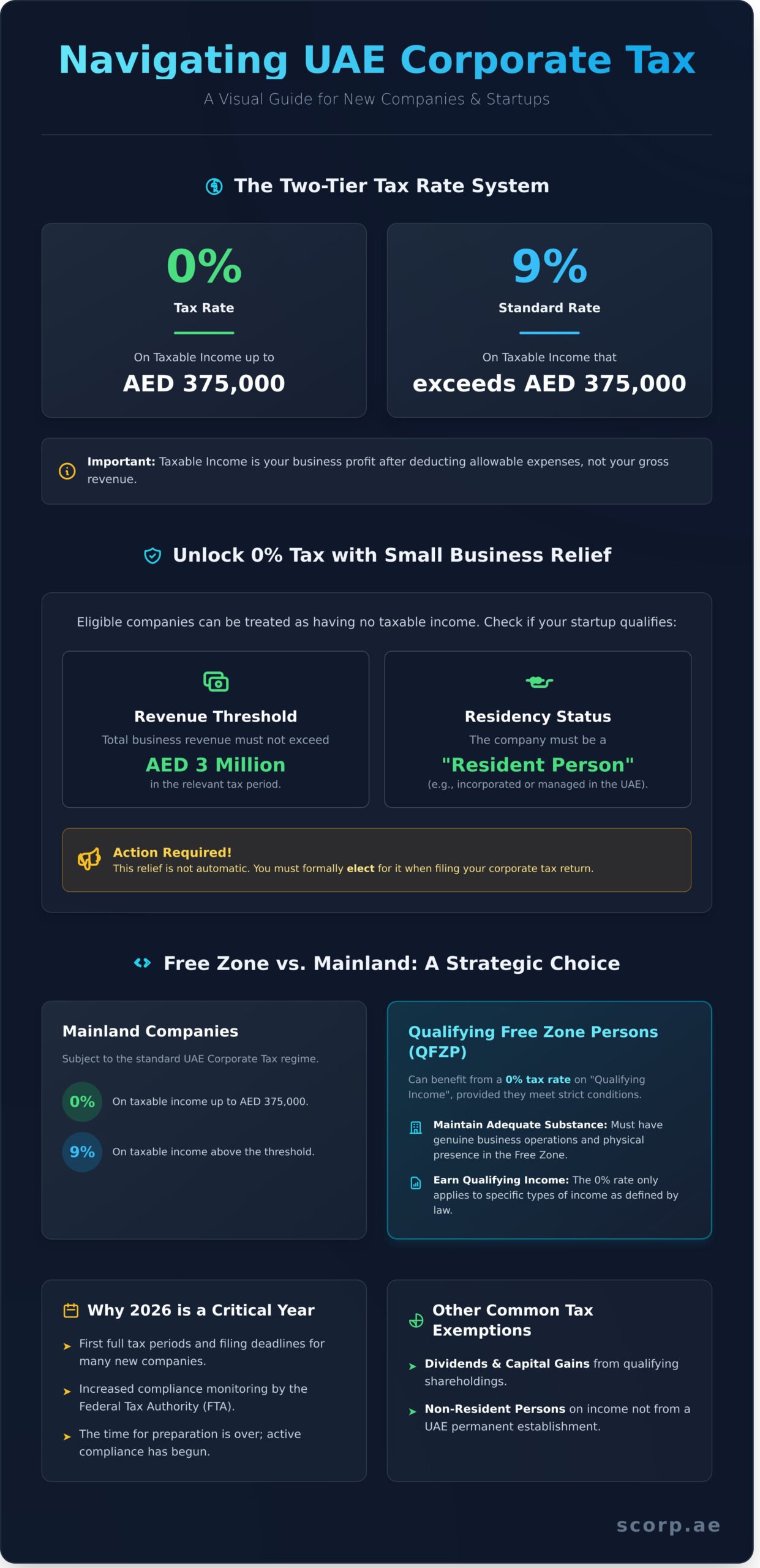
The UAE business landscape transformed on June 1, 2023, with the introduction of a federal corporate tax. This marked a significant development in the history of Taxation in the United Arab Emirates. The new system applies to most businesses and commercial activities across the country. For entrepreneurs, understanding the new uae corporate tax for new companies is essential for seamless operations and long-term success. The standard statutory tax rate is 9% on taxable income, a competitive rate designed to maintain the UAE’s attractive business environment.
Navigating these regulations from the start is crucial. New companies must establish compliant accounting practices and understand their registration and filing duties. Proactive management of tax obligations helps you avoid early penalties and build a strong financial foundation for growth. This ensures your focus remains on scaling your business, not on resolving compliance issues.
The 375,000 AED Taxable Income Threshold
The corporate tax law includes a key provision to support small businesses and startups. Companies pay 0% tax on taxable income up to 375,000 AED. The 9% tax rate only applies to the portion of income that exceeds this threshold. It is important to note that taxable income is your profit after deducting allowable business expenses, which is different from your gross revenue. This structure is designed to ease the financial burden on new ventures during their critical initial growth phase.
Why 2026 is a Critical Year for Tax
For businesses established after the law’s implementation, 2026 marks a pivotal moment. Many new companies are now entering their first full tax periods and approaching their initial filing deadlines. This means the time for preparation is over, and the era of active compliance has begun. The Federal Tax Authority (FTA) has also increased its compliance monitoring efforts. Ensuring your records are accurate and your filings are timely has never been more important for maintaining good standing.
Maximizing Small Business Relief and Tax Exemptions
The UAE has structured its corporate tax system to foster business growth. This is especially true for the uae corporate tax for new companies. The government introduced key provisions to reduce the financial burden on entrepreneurs. Small Business Relief stands out as a critical support measure. It allows eligible companies to be treated as having no taxable income. For startups and SMEs, this relief is a powerful tool. It helps preserve capital during the crucial early stages of operation. Navigating these benefits requires proactive steps, as they are not applied automatically.
Eligibility for Small Business Relief
Qualifying for Small Business Relief is a straightforward process for most startups. Your company must meet clear criteria set by the Federal Tax Authority. These conditions ensure the relief targets its intended recipients. For official guidance, businesses should consult resources from the UAE Ministry of Finance. The main requirements are:
- Revenue Threshold: Your total business revenue in a tax period must not exceed AED 3 million.
- Residency Status: The company must be a “resident person.” This typically means it is incorporated or managed and controlled within the UAE.
It is vital to remember this relief is an election. You must formally opt-in when filing your corporate tax return. Failing to do so means you will be subject to the standard tax rules, even if you meet the criteria. This simple step can have a major impact on your company’s finances.
Other Common Tax Exemptions
Beyond Small Business Relief, several other exemptions can reduce your tax liability. The UAE Corporate Tax Law includes provisions that benefit various business structures and activities. Understanding these can provide a significant financial advantage. Common exemptions include:
- Dividends and Capital Gains: Income from dividends and capital gains on “qualifying shareholdings” is generally exempt. This prevents double taxation and promotes a favorable investment climate.
- Qualifying Free Zone Persons: Companies operating in UAE Free Zones may qualify for a 0% tax rate on certain income, provided they meet all regulatory conditions.
- Non-Resident Persons: A non-resident company is typically only taxed on income from a permanent establishment in the UAE. Income earned without a permanent base is often exempt.
Some industries, such as the extraction of natural resources, operate under different tax decrees. It is essential to assess which exemptions apply to your specific business model and industry, and for professional guidance on this, you can learn more.
Corporate Tax for Free Zone vs. Mainland Companies
When establishing a business in the UAE, your choice of jurisdiction is a critical strategic decision. It directly impacts your tax obligations, compliance requirements, and market access. Mainland and Free Zone companies operate under distinct tax frameworks. Understanding these differences is the first step in creating a tax-efficient structure for your new venture.
This decision is fundamental to navigating the landscape of uae corporate tax for new companies and shapes your long-term financial health. Making an informed choice from the outset ensures your business is positioned for sustainable growth and success.
For high-level financial strategy and structuring, many growing companies partner with fractional CFO and advisory services. For example, firms like SA Unlimited specialize in providing this level of guidance for emerging and mid-cap companies.
For complex financial modeling and strategic decisions of this nature, many entrepreneurs also seek guidance from senior consultants in corporate finance. The work of experts like Saverio Canepa can provide a broader perspective on structuring international business operations for optimal financial performance.
Qualifying Free Zone Persons (QFZP) Explained
Free zones offer one of the most significant advantages in the UAE tax system. A “Qualifying Free Zone Person” (QFZP) can benefit from a 0% corporate tax rate on their qualifying income. However, this preferential status is subject to meeting strict criteria to ensure genuine business operations.
- Maintain Adequate Substance: Your company must have a real physical presence and conduct its core income-generating activities within the free zone.
- Earn Qualifying Income: This income must primarily arise from transactions with other businesses located in a free zone or with clients outside the UAE.
- Follow Compliance Rules: A QFZP must adhere to all regulatory requirements, including preparing and maintaining audited financial statements.
Mainland Business Tax Obligations
A mainland company provides unrestricted access to the entire UAE domestic market, a key advantage for many industries. These businesses are subject to the standard federal corporate tax regime. This means a 9% tax rate applies to all taxable income exceeding AED 375,000.
All mainland businesses must register for corporate tax with the Federal Tax Authority, a mandatory step regardless of revenue. For complete official guidelines, new businesses should consult the UAE Ministry of Finance Corporate Tax portal. Additionally, mainland companies are required to prepare and maintain audited financial statements to ensure full compliance with the law.
Choosing the right jurisdiction is a foundational element of your business strategy. The rules governing uae corporate tax for new companies are precise. As your trusted partner, Sarsan provides expert guidance to help you choose the best setup for tax efficiency, ensuring a seamless and successful start to your entrepreneurial journey.
Step-by-Step Tax Registration for New Businesses
Navigating the requirements for uae corporate tax for new companies begins with one crucial step: registration. Every business operating in the UAE must obtain a Tax Registration Number (TRN) from the Federal Tax Authority (FTA). This is not an optional task; it is a fundamental requirement for legal and financial compliance. Failing to register before your deadline can result in a heavy administrative penalty of AED 10,000.
To ensure a smooth process, gather all essential corporate documents before you begin. This preparation helps you avoid delays and complete the application efficiently.
The Registration Process on EmaraTax
The entire registration process is managed online through the FTA’s EmaraTax digital platform. This system is designed to streamline applications. The key steps include:
- Create Your Account: First, create a user profile on the EmaraTax portal. You will need the UAEPass mobile app for secure verification and login.
- Complete the Form: Fill out the corporate tax registration form with precise details about your company, its activities, and ownership structure.
- Upload Documents: You must upload clear copies of essential documents. This typically includes your company’s trade license and the passport copies of all directors or owners.
- Submit and Await Approval: After a final review, submit your application. The FTA will process it and issue your TRN upon approval.
Essential Record-Keeping for New Startups
Compliance with UAE corporate tax for new companies extends beyond registration. From your very first day of operation, you must maintain meticulous financial records. The law requires you to keep all financial statements, invoices, and expense receipts for a minimum of seven years. This practice is vital for calculating your taxable income accurately and preparing for potential audits.
Using professional accounting software is highly recommended to track your finances effectively. For new entrepreneurs, establishing these habits early ensures a seamless and stress-free approach to tax management. To guarantee your records are compliant and your registration is handled correctly, you can partner with corporate service experts for end-to-end support.
Ensuring Long-Term Compliance with Sarsan Corporate Services
Navigating the business landscape in the UAE extends beyond your initial company setup. The country’s tax laws continue to evolve, making ongoing compliance a critical factor for success. For entrepreneurs, the period after formation is crucial. Professional guidance prevents costly mistakes and establishes a strong foundation for managing uae corporate tax for new companies from day one.
At Sarsan Corporate Services, we provide comprehensive, end-to-end solutions that bridge the gap between business formation and tax compliance. Our role as your trusted partner is to ensure your new venture not only launches successfully but also thrives within the regulatory framework. We help you build a compliant business prepared for long-term growth.
How Sarsan Streamlines Your Tax Journey
Understanding the nuances of uae corporate tax for new companies is our expertise. We offer tailored support to make your compliance journey seamless and stress-free. Our process includes:
- Effortless FTA Registration: We manage the entire Federal Tax Authority (FTA) registration process for you. Our team ensures all documentation is accurate and submitted correctly, avoiding delays.
- Small Business Relief Evaluation: We carefully assess your business structure and revenue projections. Our experts will determine your eligibility for Small Business Relief, potentially reducing your tax burden significantly.
- Trade License and Activity Alignment: We ensure your registered business activities on your trade license perfectly match your tax classification. This crucial step prevents future discrepancies and compliance issues with the FTA.
Start Your Compliant Business Journey Today
Partnering with Sarsan allows you to focus on what you do best: growing your business. Let our experts handle the complexities of tax compliance and administrative paperwork. We are committed to providing a transparent service with clear pricing and no hidden costs, giving you complete peace of mind.
Our team is ready to provide tailored advice for your unique business needs. We invite you to book a complimentary consultation to discuss your path forward. Ready to begin? Contact our tax experts now.
Navigate Your UAE Tax Journey with Confidence
Navigating the new tax landscape is vital for your business’s success. Understanding key differences between Mainland and Free Zone companies is a crucial first step. You must also leverage benefits like Small Business Relief to ensure financial health. Proper registration and ongoing compliance are essential for sustainable growth in the UAE.
Mastering the uae corporate tax for new companies can feel overwhelming. However, you do not have to manage it alone. A trusted partner can streamline the entire process for you. This ensures your focus remains firmly on building your business from day one.
At Sarsan Corporate Services, we provide comprehensive, end-to-end corporate solutions. With expertise dating back to 1982 and transparent pricing with no hidden fees, we make compliance seamless. Let our team handle the complexities so you can achieve your goals.
Transform your entrepreneurial vision into a compliant and thriving reality. Start Your Hassle-Free Business Setup in the UAE today and build your future with a partner you can trust.
Frequently Asked Questions
Is corporate tax mandatory for all new companies in the UAE?
Yes, registration is mandatory for nearly all companies in the UAE. This includes businesses operating in both mainland and free zones. However, tax is only payable if your annual net profit exceeds AED 375,000. Understanding the rules of uae corporate tax for new companies is a crucial first step. It ensures your business remains compliant from day one.
What is the deadline for corporate tax registration for new firms?
The deadline for corporate tax registration depends on your business license’s month of issuance. For instance, a company licensed in January or February must register by May 31st of the following year. The Federal Tax Authority (FTA) has published a complete schedule. It is vital to identify and meet your specific deadline to avoid penalties.
Does a company with zero profit need to register for tax?
Yes, every company must register for corporate tax, regardless of its profitability. Even if your business generates zero profit or incurs a loss, registration is a legal requirement. You will also need to file an annual corporate tax return to declare your financial status to the authorities. This ensures full transparency and compliance with UAE law.
Can a new Free Zone company get 0% tax in 2026?
A new Free Zone company may qualify for a 0% corporate tax rate on its “Qualifying Income.” To receive this benefit, your company must meet specific conditions. These include maintaining adequate substance in the UAE and complying with all regulatory requirements. This is not an automatic exemption and depends on the nature of your business activities.
How much is the penalty for late corporate tax registration?
The administrative penalty for late corporate tax registration is AED 10,000. This fine is imposed by the Federal Tax Authority if a company fails to submit its registration application by the specified deadline. Timely registration is a simple and effective way to avoid this significant financial penalty and ensure your new venture starts on a compliant footing.
What documents are needed for corporate tax registration?
The registration process requires a few key documents. You will typically need a valid copy of your company’s trade license. Additionally, you must provide the passport and Emirates ID of the authorized signatory. Having these documents prepared in advance will help streamline the registration on the EmaraTax portal for a seamless process.
Does UAE corporate tax apply to personal salary?
No, the UAE corporate tax system does not apply to an individual’s personal salary. The tax is levied on the profits of corporations and businesses. Personal income from employment, real estate investments in a personal capacity, and other individual earnings remain free from this tax. This distinction protects the personal wealth of employees and entrepreneurs.
Can I apply for Small Business Relief every year?
Yes, you can elect to apply for Small Business Relief for each relevant tax period. To qualify, your company’s revenue must be below AED 3 million in that period. This relief is not automatic; you must make an election when filing your tax return. If your revenue stays below the threshold, you can continue to apply for it annually.