






















In 2026, a UAE holding company serves as a vital shield for your global assets instead of a simple tax vehicle. You probably feel concerned about the recent shift toward a 9% corporate tax rate and complex e-invoicing mandates. This UAE holding company guide helps you navigate these regulatory changes with confidence and professional clarity. We understand that choosing between Mainland and Free Zone jurisdictions feels like a daunting task for any ambitious investor.
Establishing a robust structure allows you to centralize management while ensuring your international wealth remains secure and private. You’ll learn how to qualify for the 0% participation exemption on dividends through proper economic substance planning. This article outlines the registration process, compares setup costs, and explains how to avoid the AED 10,000 non-registration penalty. By the end, you’ll have a clear roadmap to optimize your tax strategy and simplify your global business operations.
Key Takeaways
- Learn how a holding structure separates your personal assets from operational risks through a secure and professional parent-subsidiary framework.
- Additionally, compare the strategic differences between Mainland, Free Zone, and Offshore jurisdictions to find the most prestigious legal home.
- Then, this UAE holding company guide reveals how to leverage the 0% tax rate while protecting global wealth.
- Finally, identify the essential compliance steps to ensure your entity meets the 2026 economic substance and tax registration requirements.
Understanding the Fundamentals of a UAE Holding Company
A holding company acts as a strategic legal entity designed to own and control other businesses or assets. Unlike a traditional firm, it does not engage in the daily manufacturing or selling of commercial products. Instead, it serves as a central hub for managing investments, intellectual property, and real estate. What is a Holding Company? overview confirms that its primary purpose is administrative control rather than active operations. By 2026, the UAE has become a premier global destination for these structures due to its modern legal framework. This UAE holding company guide provides the clarity you need to protect your international wealth effectively.
In the UAE legal framework, the parent company sits at the top of the corporate hierarchy. It holds the majority of shares in one or more subsidiaries, which perform the actual business activities. This structure creates a clear distinction between the entity that owns the assets and the entities that take risks. Standard operating companies focus on trade, while holding structures focus on the long-term preservation of capital. Consequently, business owners can manage multiple diverse ventures under a single, unified corporate umbrella with high efficiency. Recent updates like Federal Decree-Law No. 20 of 2025 have further simplified how these entities operate on the mainland.
How Holding Structures Work in the UAE
The mechanism of shareholding allows the parent company to control local and international subsidiaries from a central point. Dividends and capital gains flow upward from the active subsidiaries to the parent entity for reinvestment or distribution. However, holding company license holders must respect specific limitations regarding active commercial trading within the local market. They cannot sell goods or provide services directly to consumers like a retail or consultancy firm would. Instead, their role remains strictly focused on ownership, oversight, and strategic management of their diverse asset portfolio. This focus ensures that the parent entity remains insulated from the daily operational challenges of its subsidiaries.
The Legal Separation of Assets and Risks
One of the most significant advantages of this structure is the effective ring-fencing of financial and legal liabilities. Each subsidiary maintains an independent legal personality, meaning its debts do not automatically transfer to the parent company. If one subsidiary faces a legal claim or financial loss, the assets held by the parent remain secure. This protection is vital for investors who manage high-risk ventures alongside stable long-term investments like real estate. A dedicated management board oversees the entire portfolio, ensuring that each entity follows local compliance and 2026 tax regulations. Professional Company Formation Services provide the necessary guidance to establish these complex structures correctly from the start.
Choosing the Right Jurisdiction for Your Holding Structure
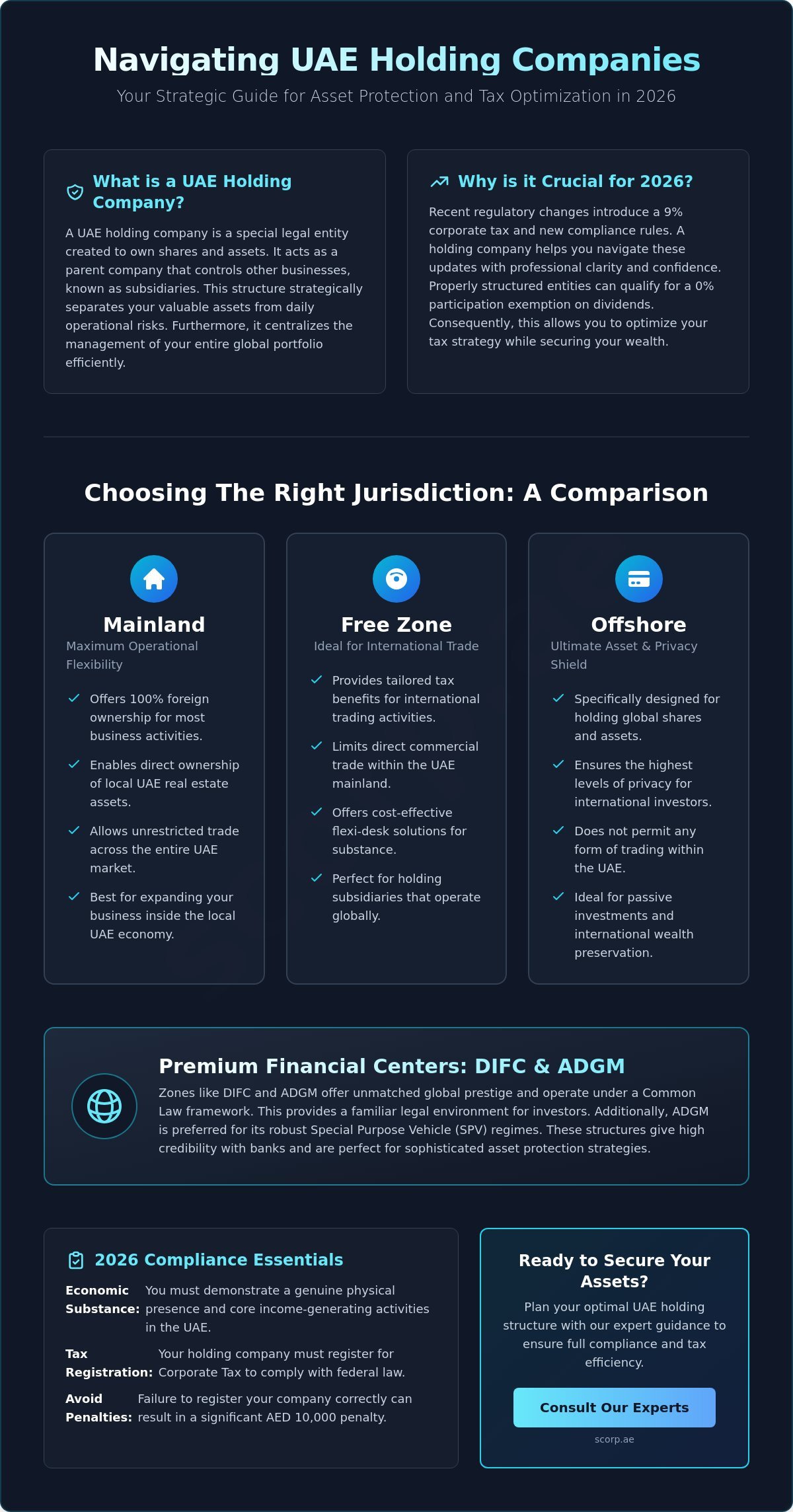
Choose the ideal jurisdiction as your most critical decision when planning a UAE holding company strategy. You should evaluate Mainland, Free Zone, and Offshore options based on your specific asset types and business goals. Each zone offers distinct legal protections and operational limits that directly impact your long-term success. For instance, Mainland entities now allow 100% foreign ownership for most commercial activities under recent 2025 legislative updates. Meanwhile, Offshore jurisdictions like RAK ICC remain popular for holding international assets while maintaining high levels of privacy. Selecting the correct location ensures your structure remains efficient and fully compliant with the 2026 regulatory environment.
Mainland vs. Free Zone Holding Companies
Mainland holding companies provide the greatest operational flexibility, especially if you plan to own local UAE real estate. These entities can contract directly with government bodies and operate across the entire country without geographic restrictions. In contrast, Free Zone structures often provide tailored tax advantages for qualifying income but limit your onshore trade. Regarding physical requirements, most jurisdictions now require a demonstrable presence to meet Economic Substance Regulations (ESR) in 2026. While Mainland setups usually involve traditional office leases, many Free Zones offer cost-effective flexi-desk solutions for holding entities. Licensing costs also vary significantly between Emirates like Dubai, Abu Dhabi, and Sharjah.
- Mainland: Best for local market expansion and direct property ownership in the UAE.
- Free Zone: Ideal for international trading subsidiaries and specific industry-focused tax benefits.
- Offshore: Designed for asset protection and holding global shares without trading within the UAE.
The Rise of Financial Centers: DIFC and ADGM
Premium financial centers like the Dubai International Financial Centre (DIFC) and Abu Dhabi Global Market (ADGM) offer unmatched prestige. These zones operate under a Common Law framework, which provides a familiar legal environment for international investors. ADGM is particularly preferred for sophisticated asset protection due to its robust Special Purpose Vehicle (SPV) regimes. These structures offer high credibility with global banks and are perfect for managing intellectual property or private equity. While setup costs in these zones are higher, the legal certainty they provide justifies the initial investment. If you need help deciding, our experts in Business Formation can analyze your specific portfolio needs.
International investors often choose ADGM for its streamlined digital registration process and transparent regulatory standards. This jurisdiction provides a secure environment for high-value assets and family office structures. Similarly, DIFC remains a top choice for those requiring access to a vast network of financial services. Both zones ensure that your holding company remains a respected entity in the global financial community. By aligning your jurisdiction with your asset class, you create a foundation for sustainable growth and security.
Strategic Benefits: Why Investors Choose the UAE in 2026
Investors choose the UAE because it offers a stable environment for global wealth management and capital growth. This UAE holding company guide highlights how these structures facilitate the seamless movement of capital across borders. Beyond simple ownership, these entities provide a robust framework for long-term succession and legacy planning for families. You can transfer ownership interests easily without disrupting the underlying operations of your various business units. This continuity is essential for preserving wealth across multiple generations while maintaining a professional corporate image.
The UAE banking system supports this efficiency by allowing for the rapid movement of international funds. You’ll find that local banks are well-versed in the specific needs of holding structures and SPVs. This financial infrastructure makes it easier to manage cash flow across a diverse group of international subsidiaries. High-tier jurisdictions like ADGM and DIFC offer even stronger banking acceptance for those dealing with institutional investors. These features combine to create a world-class ecosystem for asset management and corporate expansion.
Asset Protection and Risk Mitigation
A holding structure creates a powerful “firewall” that protects your parent company from the liabilities of its subsidiaries. If an individual business faces a legal claim, the assets held at the top level remain completely secure. You can also centralize your intellectual property within the holding company to simplify licensing and increase protection. Read our guide on how to build a business in Dubai for foreigners to understand the wider market landscape. This separation ensures that one failing venture doesn’t jeopardize your entire financial portfolio.
Tax Efficiency in the 2026 Regulatory Landscape
The 2026 tax landscape introduces a 9% corporate tax on income that does not meet qualifying criteria. However, holding companies often benefit from a 0% rate on dividends and capital gains through the participation exemption. To qualify, the parent must typically own at least 5% of the subsidiary for a 12-month period. Understanding the UAE holding company tax rules is vital for maintaining your global compliance and financial health. The subsidiary must also be subject to a tax rate of at least 9% in its home country.
The UAE’s vast network of Double Taxation Treaties helps you avoid paying taxes in multiple jurisdictions. Regarding VAT, most holding activities remain outside the scope of tax, which simplifies intra-group transactions and bookkeeping. These strategic advantages allow you to reinvest more of your profits into future growth and asset acquisition. Managing these requirements correctly ensures you maximize your tax savings while remaining fully compliant with the Federal Tax Authority.
Step-by-Step Setup and Ongoing Compliance Requirements
Setting up a holding company requires a highly structured approach to documentation and various legal filings. Shareholders must provide clear passport copies and proof of residency to begin the initial approval phase. This UAE holding company section clarifies how to navigate the registration path without facing unexpected delays. You must also submit a comprehensive business plan that outlines your proposed asset portfolio and management structure. Having these documents ready ensures a frictionless experience during the early stages of your company formation journey.
The Licensing and Registration Process
The process starts with reserving a unique trade name and obtaining initial approval from the relevant authority. Afterward, you must draft and sign the Memorandum of Association to define the company’s internal regulations. Professional Company Formation Services simplify these steps by handling all government interactions on your behalf. For specific details on zone-based requirements, consult our Dubai Free Zone company setup guide. Once the license is issued, the entity becomes a legal person capable of holding shares in other firms.
Maintaining Compliance: ESR, UBO, and AML
Compliance remains a continuous obligation that extends far beyond the initial registration of your holding entity. Economic Substance Regulations (ESR) require companies to demonstrate actual core income-generating activities within the UAE borders. Additionally, you must maintain an accurate Ultimate Beneficial Owner (UBO) register to ensure full transparency with local regulators. Anti-Money Laundering (AML) checks have also become more stringent in 2026 to align with international financial standards. If you don’t file these reports on time, you may face significant financial penalties or license suspension. Failing to register with the Federal Tax Authority results in a mandatory penalty of AED 10,000 in 2026.
Opening a corporate bank account in Dubai now requires thorough background checks and detailed source-of-wealth documentation. Banks in 2026 prioritize entities that show clear management structures and compliant filings from the beginning. Having a reliable partner ensures that your application meets the high standards of local and international financial institutions. It’s much easier to secure approval when your compliance history is clean and your documentation is thorough. If you are ready to secure your assets, contact our experts to begin your journey today.
Maximizing Asset Growth with Sarsan Corporate Services
Sarsan Corporate Services adopts a holistic and professional approach to all your global asset management needs. We don’t just register companies; we build secure foundations for your long-term business continuity and growth. Our team prioritizes financial clarity and ensures the UAE holding company guide shows how a professional partner simplifies even the most complex structures. You receive a dependable collaborator who understands the nuances of regional regulatory frameworks and ownership models. We aim to transform your ambitious business goals into achievable outcomes through expert and dedicated guidance. Our seasoned experts offer a calm and efficient experience for every client exploring the UAE market. We believe that transparency is the most important factor when building a long-term professional relationship.
Why SCORP is Your Strategic Partner in the UAE
Choosing the right structure requires a deep understanding of your specific investor goals and risk profile. We provide personalized consulting services that match your asset portfolio to the most prestigious UAE jurisdictions. Our team delivers extreme speed and efficiency through our Dubai business setup services. We manage the complex 2026 regulatory changes so you can focus on growing your international wealth. Our expertise covers everything from Economic Substance Regulations to the latest e-invoicing and tax registration mandates. This comprehensive approach ensures that your holding entity remains compliant and fully operational from day one. We act as your dedicated guide through every step of the formation and residency visa process. Our commitment to excellence means you always receive the most accurate and up-to-date regulatory information.
Take the First Step Toward Secure Asset Holding
It’s a straightforward process to transition from education to execution when you have a seasoned guide. We invite you to book a consultation for a tailored strategy that secures your family’s financial legacy. Our experts provide the peace of mind you need to manage multiple subsidiaries with total confidence. Visit our contact page for immediate assistance with your company formation or residency visa requirements. You can also follow our journey on Instagram for daily updates on the UAE business landscape. Let us help you unlock the full potential of being a UAE entrepreneur in this article. We look forward to collaborating with you to achieve your global business and investment objectives. Start your journey today and discover the benefits of a professionally managed UAE holding company structure.